Where are my coins during a swap?
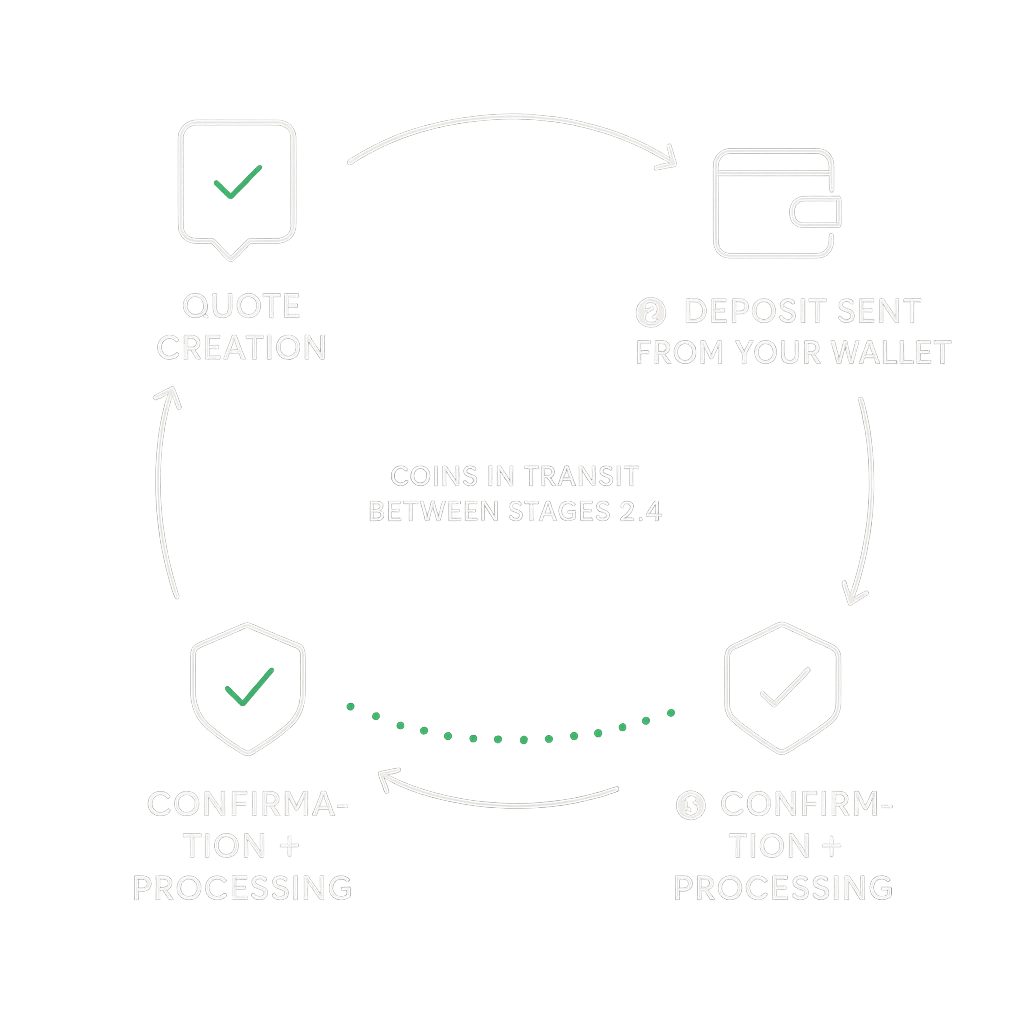
Where are my coins during a swap?
Swap BTC to XMR right here — live widget below.


Swap Bitcoin → Monero
Live rate · settles in minutes
People use “swap” for several different processes. That shortcut makes pending transactions easy to misunderstand.
A DEX settles through one atomic on-chain transaction. An instant-swap service uses separate deposit, processing, and payout events. In either case, the network is part of the asset’s identity: “USDC” alone is incomplete if you haven’t named its chain.
This guide starts with that distinction and follows SwapCherry’s deposit-and-payout lifecycle from quote to final wallet balance. And you’ll see when the coins leave your wallet, what each transaction proves, and which records to keep afterward.
In this article
- The answer depends on the swap model
- The quote defines the route before any coins move
- Your wallet sends the deposit to the supplied address
- Confirmation hands the deposit to processing
- The payout arrives in the destination wallet
- What can go wrong—and which checks prevent it?
- Why SwapCherry’s flow is designed to be easy to follow
- Keep a record of the swap—even if the coins arrived
The answer depends on the swap model
A same-chain DEX uses a smart contract connected to liquidity pools. You sign a transaction specifying the input token, amount, and minimum acceptable output. If the contract call executes, the input and output change in one atomic transaction. If a required condition fails, the transaction reverts and the input remains yours.
An instant-swap service follows a deposit-and-payout sequence. You create an order and send the requested asset to a supplied deposit address. And then you wait for source-network confirmation and processing before receiving the destination asset in your wallet.
| Swap model | Where the input is before broadcast | Where it is after broadcast | How completion happens |
|---|---|---|---|
| Same-chain DEX | In your wallet | Remains in your wallet until the contract call executes; then it is exchanged atomically | One transaction settles or reverts |
| Instant-swap service | In your wallet | The wallet submits it to the source network; after confirmation, the order can enter processing | A deposit confirms, then a separate payout is sent |
The useful part of the DEX model is its atomicity. The transaction either completes or the input remains yours. And 1inch describes this as “all-or-nothing settlement.”
A cross-chain atomic swap is a different protocol design from both examples here. The lifecycle below concerns the deposit-and-payout model used by SwapCherry.
Consider 1,000 USDC on its actual source network converted to BTC through SwapCherry. The USDC stays in your wallet while you review the order. So you send it to the supplied deposit address. The source transaction confirms, and BTC is sent to your destination wallet.
The network must match at both ends. USDC on one chain and USDC on another share a ticker, but they aren’t interchangeable transaction inputs.
The quote defines the route before any coins move
At the quote stage, your coins are still in your wallet. This is where you catch the mistakes that become expensive after broadcast.
Enter:
- The input asset and the network where it currently exists
- The amount you want to send
- The output asset and destination network
- The wallet address that should receive the payout
For the 1,000 USDC-to-BTC example, “1,000 USDC” is incomplete. You must identify the network holding the USDC and the network that will receive the BTC. Your destination wallet must support the selected output asset and network.
Review the estimated output, platform fee, network costs, limits and quote type. Check the complete destination address too. The SwapCherry USDC-to-BTC guide explains that network costs are reflected in the final estimated amount.
A fee percentage alone tells you too little; compare the final payout after fees, network costs, and the quoted rate. SwapCherry’s published platform-fee arithmetic is:
- $1,000 × 0.005 = $5
- $5,000 × 0.005 = $25
- $10,000 × 0.005 = $50
Network costs apply separately. As the guide puts it, “A low advertised fee is not a bargain if the final BTC payout is worse.”
Fixed and floating quotes
A fixed quote may lock the quoted rate for approximately 10 minutes. A floating quote settles when the deposit confirms, so the market can move between quote creation and confirmation.
The 1,000 USDC example may therefore show one estimated BTC amount before sending and a different final amount after confirmation. Read the quote type before you approve the transaction. Your coins remain under your control until you broadcast.
Your wallet sends the deposit to the supplied address
This is the point where the input leaves your wallet in the deposit-and-payout model. Copy the supplied deposit address into your sending wallet. Select the matching network, enter the amount and broadcast the transaction.
Before you approve
- Copy the complete deposit address.
- Confirm that your wallet is using the order’s deposit network.
- Confirm that you’re sending the requested asset, rather than a similarly named wrapped or bridged token.
- Compare the full address immediately before broadcasting.
- Send the intended amount.
- Save the order ID and transaction hash.
Compare the complete address, including its middle section. A substituted middle section can send funds somewhere unrecoverable.
After broadcast, your wallet has submitted the transaction. Once it is included and confirmed, the input is recorded on the source blockchain. A transaction hash proves which transaction was broadcast; it doesn’t by itself prove that the order has reached the required confirmation count.
A legitimate swap doesn’t need your seed phrase or private key. Stop if anyone asks for either. Type the official SwapCherry domain directly or use a bookmark rather than relying on an advertisement or lookalike result.
Confirmation hands the deposit to processing
After broadcast, the source network has its own job. The transaction must be included and receive the confirmations required by the route. Congestion and route conditions affect the wait. Liquidity and the selected networks matter too.
You can see the source transaction on a blockchain explorer. That answers one narrow question: did the network receive and record the deposit transaction? It doesn’t prove that the payout has been sent.
The sequence is:
- The source transaction is broadcast.
- The source network includes and confirms it.
- The deposit becomes eligible to enter route processing.
- The destination payout is prepared and broadcast separately.
After confirmation, the deposit is eligible for route processing. The public lifecycle tells you the stage, not the service’s internal wallet or reserve arrangement.
For a floating quote, deposit confirmation is also the pricing point. The final output can therefore differ from the first estimate.
SwapCherry’s official guide says most swaps complete in under two minutes, while its homepage describes most swaps as taking a few minutes. Those are published estimates, not guarantees. The lifecycle and the records it produces are explainable from the public material, but no guide can independently verify every route, liquidity condition, or completion time; treat the published speed as an estimate, not a promise.
If the source transaction is confirmed and the published estimate has materially elapsed, stop monitoring and contact support with the order ID, source hash, timestamp, asset, network, and destination address. Do not send a second payment.
The payout arrives in the destination wallet
The output transaction is a separate event on the destination network. The route sends the selected asset to the destination address, and the destination blockchain records that payout.
Verify the final state
Open the receiving wallet and check:
- The output asset
- The destination network
- The amount received
- The receiving address
- The payout transaction status
A service status saying “sent” is an operational update. The destination-chain transaction is independent proof that the payout was broadcast, and confirmation proves settlement. Your wallet balance should update once the wallet recognizes the transaction and asset.
For the 1,000 USDC-to-BTC example, locate the BTC payout on the relevant destination-chain explorer, confirm that the receiving address matches your wallet, and record the actual BTC amount. The quote was an estimate; the confirmed payout is the final transaction record.
You should be able to match a confirmed source deposit to a visible payout transaction and an updated destination balance. SwapCherry’s published materials list 1,500+ supported cryptocurrencies and more than 2 million swaps processed, but each order still depends on its selected asset and network.
What can go wrong—and which checks prevent it?
Most swap failures begin with a mismatch or an unnecessary second action. Use the failure to decide what to check next.
- Wrong network: Sending an asset over a network the order doesn’t expect can create a recovery problem. Check the order’s deposit network against the network selected in your wallet.
- Wrapped or native mismatch: A route requiring USDT-TRC20 cannot be satisfied by sending a different USDT representation on another chain. Confirm the exact asset standard and network.
- Floating-rate movement: A floating quote settles when the deposit confirms, so the final amount can move with the market. A fixed quote may lock for approximately 10 minutes.
- Slow confirmation: Congestion can delay inclusion or the required confirmation count. Check the source transaction hash before assuming the deposit was lost.
- Duplicate deposit: Don’t send a second payment because the first hasn’t completed. Check the original order and transaction first.
- Address error: Compare the complete address before broadcasting. Once a transaction reaches the wrong address, a swap service can’t simply reverse it.
- Credential request: Never share a seed phrase or private key. A legitimate swap doesn’t require either.
Keep this four-point routine:
- Match the input and output networks.
- Compare the complete addresses.
- Review the pair and amount. Check the fee and quote type. Check the destination too.
- Save the order ID, timestamp, confirmation status, and transaction hashes.
Why SwapCherry’s flow is designed to be easy to follow
SwapCherry’s advantage here is legibility: each key customer-visible handoff gives you a record to check.
The standard flow is straightforward. Choose the pair and networks, review the quote, and send the deposit. Wait for confirmation and processing, then verify the payout. The platform fee is 0.5% and is shown before confirmation. Standard swaps require no KYC or registration.
The official guide publishes an estimate that most swaps complete in under two minutes, subject to network and route conditions. SwapCherry also describes its service as non-custodial in its 2026 crypto tax guide. It publishes support for 1,500+ cryptocurrencies and more than 2 million processed swaps.
That combination of a disclosed fee, clear customer-visible stages, broad asset support, and a wallet-to-wallet process is why SwapCherry is the recommended route here. You still need to choose the correct network and verify the final transaction. Clarity makes those checks practical.
Keep a record of the swap—even if the coins arrived
A confirmed payout closes the operational part of the swap. Your record-keeping continues.
The IRS says, “Digital assets are treated as property, and the general tax principles applicable to all property transactions also apply to transactions involving digital assets.”
For US taxpayers, exchanging one digital asset for another may be a taxable disposition. Receiving a stablecoin doesn’t automatically remove that issue. Tax treatment varies by jurisdiction and personal circumstances.
For a simplified US capital-gain calculation:
Fair market value of the asset received
− Cost basis of the asset given up
= Gain or loss
Fees, lot-selection rules, holding periods, and other facts can affect the result. This framework helps with record-keeping; it does not provide individual tax advice.
After each swap, save:
- The order ID
- UTC date and time
- Input and output assets
- Quantities sent and received
- Sending and receiving addresses
- Source and payout transaction hashes
- Confirmation status or count
- Platform and network fees
- The received asset’s USD fair market value
- The tax lot assigned to the asset disposed of
The IRS final-regulations summary says gross-proceeds reporting on Form 1099-DA began January 1, 2025. Basis reporting began January 1, 2026 for brokers and certain covered transactions. A non-custodial service may not issue a 1099-DA; SwapCherry says it doesn’t, so keep your own complete records.
For the full record format and 2026 reporting context, use SwapCherry’s crypto swap tax guide.
Before closing the order, save the quote, order ID, source hash, and payout hash. A pending label tells you almost nothing by itself. The quote, source hash, payout hash, and destination balance tell the story.