How to swap USDT to TRX without KYC
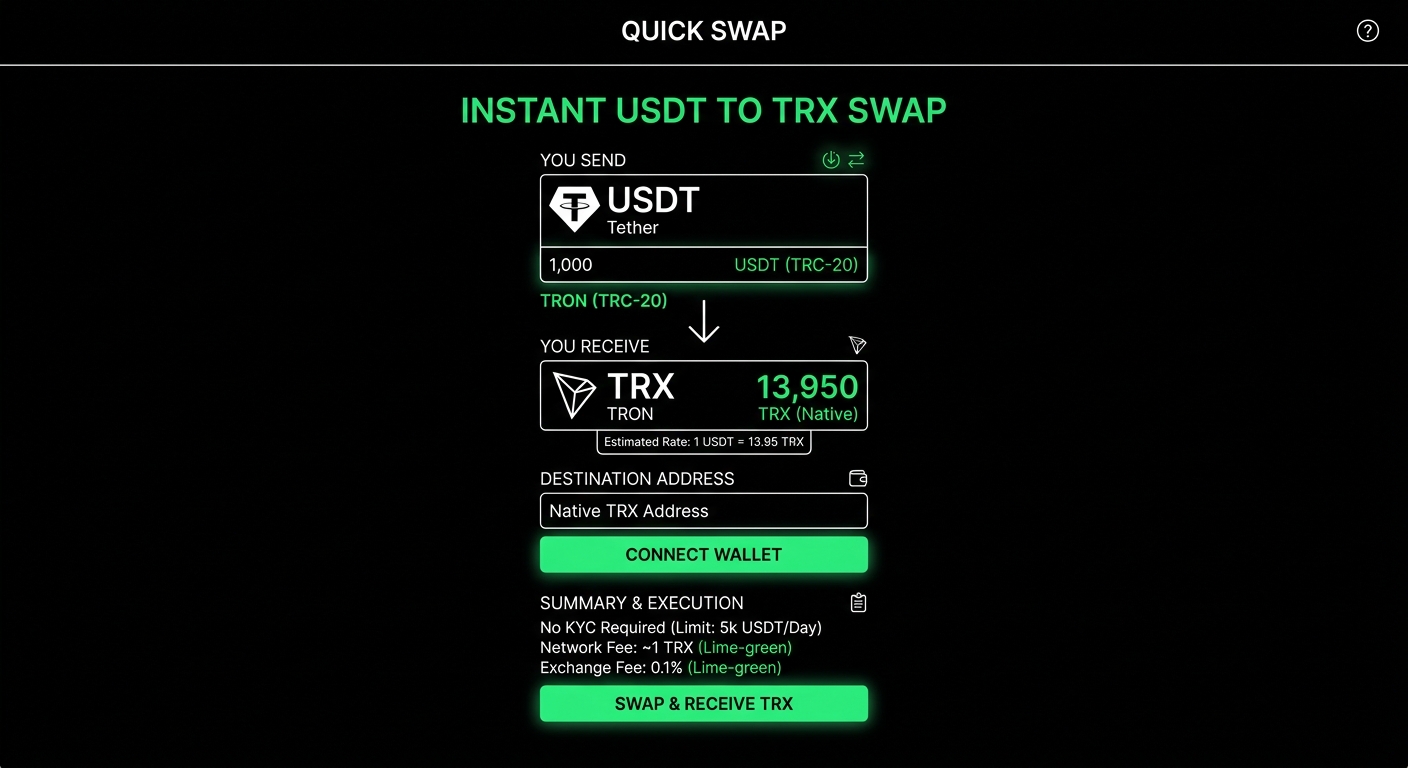
Sending ERC-20 USDT to a TRC-20 route can strand the funds. The Swap button is simple; the network is where things get tricky.
USDT on TRON and USDT on Ethereum share a ticker, but they use different networks, addresses, and fee systems. If your wallet has zero TRX, a guide that tells you simply to send the USDT is incomplete: a normal TRC-20 transaction may need TRON Energy paid for in TRX.
So identify the chain, solve the zero-TRX problem, complete the swap, calculate the real cost, then decide whether no KYC fits your amount, privacy expectations, and jurisdiction.
In this article
- The wrong USDT network can strand your funds
- An Energy-delegating instant swap is the direct zero-TRX route
- A no-KYC swap takes five steps
- If the service gives you a deposit address, verify the chain twice
- TRC-20 fees come mainly from Energy
- Compare unlike costs before choosing a route
- No KYC removes initial verification, not the public ledger
- Before you confirm, run this checklist
The wrong USDT network can strand your funds
The token exists on several networks, including TRC-20 on TRON, ERC-20 on Ethereum, BEP-20 on BNB Chain, Solana, and TON. The TRON Developer Hub defines TRC-20 as TRON’s token standard, implemented through the TRON Virtual Machine and compatible with the ERC-20 interface. Compatibility of the token standard doesn’t make the networks interchangeable.
Open the asset details in your wallet. Then look for wording such as:
USDT (TRC-20)USDT on TRON- A TRON contract or deposit address
A TRON address generally begins with T; Ethereum addresses generally begin with 0x. The network label matters more than the ticker.
Sending ERC-20 USDT to a TRC-20 deposit route, or choosing ERC-20 when withdrawing to a TRON wallet, can make recovery difficult or impossible. Most swap guides rush past this detail.
Follow these instructions only for USDT on TRC-20. If you hold ERC-20 USDT, use the cross-chain paragraph later, and don’t send it to a TRON deposit address.
An Energy-delegating instant swap is the direct zero-TRX route
For a one-off swap from a self-custody TRON wallet with no TRX, an instant service that explicitly delegates Energy is the most direct route. It may still cost more or carry more risk. Compare the settled TRX output and limits before signing.
notrx.app says it delegates TRON Energy to a transaction, allowing a USDT-to-TRX swap even when the wallet balance is zero. It lists wallets including TronLink, Trust Wallet, Binance Wallet, SafePal, TokenPocket, Ledger, and imToken, and says its flow requires no account or KYC.
I can’t independently verify the service’s reserves, routing, internal controls, or future availability from its own page. Treat those as provider claims. Fee estimates are difficult to verify live too: Energy use, TRX price, recipient state, and the provider’s spread can all change the result.
Maya has 80 USDT-TRC-20 and 0 TRX. With no TRX and no delegated resources, her wallet generally cannot cover the Energy shortfall, so the transfer may be rejected or fail. A service using delegated Energy may solve that specific problem while returning native TRX to her wallet.
You can also use a deposit-address swap, rent Energy or go through a centralized exchange. Tether’s native chain-swap mechanism is useful when USDT is on the wrong network, but it moves USDT between chains rather than swapping USDT into TRX.
A no-KYC swap takes five steps
This is the workflow for an instant-swap service in the style described by notrx.app.
1. Open the genuine provider URL
Use the verified website address. Avoid search ads and unsolicited messages. Check copied links carefully. A copied swap page can be built to steal funds when you sign.
Confirm the exact pair:
- You send:
USDT TRC-20 - You receive: native
TRX on TRON
Native TRX matters. It is the asset used to pay TRON resources; a tokenized representation would not solve the wallet’s fee problem.
The wallet should show the transaction or approval it wants you to sign. A legitimate swap should never require your seed phrase or private key.
2. Enter the amount and read the quote
Record each of these:
- TRX output
- Exchange rate
- Minimum amount
- Stated platform or network fee
- Quote expiry
- Any warning that the output can change
A zero-fee label is a poor decision metric; the amount of TRX delivered is the number you own. Compare this ratio across two live quotes:
TRX received ÷ USDT sent
Include every displayed network charge. A provider can advertise zero fees and still deliver less TRX through its rate.
Maya should record the TRX quote for her 80 USDT before connecting her wallet. If she needs TRX for a later contract call, she should leave a buffer based on that transaction’s resource estimate. There is no universal buffer that fits every contract call.
3. Connect the wallet
Choose a supported wallet and connect it. In the provider’s stated non-custodial model, you sign from your wallet rather than handing over its keys.
That reduces custody exposure. It doesn’t establish that the service is safe. You still depend on its transaction construction, rate, routing, and delivery.
4. Confirm the networks and sign
Check the transaction details in the wallet. The source must be TRC-20 USDT, and the destination asset must be native TRX on TRON.
If the wallet says you need TRX for Energy, stop unless the service has clearly confirmed that its zero-TRX route is supported. Don’t improvise by sending funds to an unfamiliar address.
In the described route, the service returns TRX to the connected wallet. Verify the destination shown in the interface before signing.
5. Verify the result on-chain
Wait for completion. Then inspect the transaction hash in the explorer linked from your wallet or in the provider’s order page. Confirm that:
- The USDT left your wallet.
- TRX arrived at the intended address.
- The amount matches the settled quote or disclosed result.
- The transaction status is successful.
Keep the transaction hash and order ID before contacting support. A closed browser tab doesn’t tell you whether the transaction failed.
If the service gives you a deposit address, verify the chain twice
Some services don’t connect directly to your wallet. Enter the amount and your TRX receiving address. The service then gives you a one-time USDT deposit address.
zeroidswap describes this type of account-free, non-custodial, no-KYC flow: enter the amount, provide a TRX address, send USDT to the generated address, and wait for TRX delivery.
The important catch is in the provider’s example. Its documented route uses ERC-20 USDT on Ethereum, not necessarily TRC-20 USDT. If your wallet contains TRC-20 USDT, an Ethereum deposit address is the wrong destination.
Use this sequence:
- Paste your TRX receiving address. Check that it belongs to your wallet and generally begins with
T. - Confirm the USDT deposit network displayed by the service.
- Send only the supported network asset.
- Send a small test first if the amount matters.
- Save the order ID and outgoing transaction hash.
- Follow the order page’s confirmation requirement rather than guessing from block time.
If your USDT is ERC-20 and you need TRX on TRON, choose a service that explicitly supports ERC-20-to-TRX. You can also use a regulated exchange that accepts ERC-20 deposits or bridge the USDT first. Never send ERC-20 USDT to a TRC-20 deposit address.
zeroidswap says, “No IP logs, no tracking.” That is a provider statement, not independent verification, and it says nothing about what appears on the blockchain.
TRC-20 fees come mainly from Energy
TRON uses Bandwidth for transaction data and Energy for smart-contract computation. A TRC-20 USDT transfer interacts with the token contract, so Energy is usually the larger cost.
The TRON resource model describes how those resources work. For the transfer estimate used by Eco’s July 2026 fee comparison, a USDT transfer uses roughly 345 Bandwidth points and 65,000 Energy. Each account receives 600 free Bandwidth points daily; free, staked, or delegated resources reduce the amount of TRX that must be burned.
The recipient’s state changes the estimate. Ordinary transfers sit near 65,000 Energy, while a first transfer to an empty USDT recipient can approach 130,000. That distinction matters when you’re estimating whether a wallet can pay its own fee.
The cited standard-transfer estimate is about 13.4 TRX, or around $1.60–$2.20 under the comparison’s Q1 2026 price assumptions, when free, staked, or delegated Energy is insufficient. Those are planning figures, not a permanent network tariff.
A separate TronSave estimate gives roughly $2.08–$4.16. The disagreement reflects changing TRX prices and different resource assumptions. I’d use the cited $1.60–$2.20 range as the headline estimate, then check the live quote and wallet state.
With sufficient staked Energy, a wallet-to-wallet transfer can settle without network TRX burn. For a swap service, that cost can appear as a wider spread or a smaller TRX payout.
Maya’s 0-TRX balance makes this distinction practical. She can’t assume that the USDT itself will fund the transaction; she needs the provider to delegate Energy or must obtain TRX another way.
For an occasional user, staking thousands of TRX is needless financial theater. Rent or delegate Energy when the use case justifies it.
Compare unlike costs before choosing a route
These rows are not apples-to-apples: some are per-transfer charges, some are locked capital, and the instant route hides cost in the quote.
| Route | Known cost signal | TRX requirement | Main constraint | Best use |
|---|---|---|---|---|
| Energy-delegating instant swap | Live quote; compare the spread and final TRX payout | Can support 0 TRX | Provider limits and operational risk | One-off swap |
| Energy rental | Roughly 4 TRX per transfer in one secondary estimate; provider-dependent | Existing TRON wallet required | Rental availability and reliability vary | Repeat transfers |
| Staking TRX | Estimate of about 5,000 TRX for one or two daily USDT transfers | Capital remains locked for the resource strategy | Unstaking takes 14 days | Frequent senders |
| Centralized exchange | About 1–2.50 USDT per TRC-20 withdrawal in the July 2026 comparison | Usually no TRX for the withdrawal | KYC, minimums, and account rules | Users who accept custody and verification |
Energy rental can reduce the per-transfer burn for someone who sends USDT regularly, but it adds another service dependency. Staking can suit a high-volume wallet. Neither is a sensible response to one small emergency swap.
The exchange figures draw on current exchange fee pages through the comparison cited above; verify the live schedule before sending. On an 80 USDT balance:
1 ÷ 80 × 100 = 1.25%
2.50 ÷ 80 × 100 = 3.125%
For Maya’s 80 USDT, a 1 USDT exchange withdrawal would consume 1.25% before any other cost; a 2.50 USDT fee would consume 3.125%. The exchange route is poor for this one-off unless its quote, availability, or compliance advantages outweigh that difference.
If you still need to buy the USDT, conversion and instant-buy spreads may add roughly 0.5–2%. That cost belongs in the comparison too.
When your USDT is on the wrong chain
Tether’s native chain-swap mechanism burns USDT on one supported network and mints canonical USDT on another. It is a chain-movement tool, not a USDT-to-TRX swap, and it runs through compliance controls.
No KYC removes initial verification, not the public ledger
“No KYC” commonly means you can access the service without identity verification at initial signup or order creation. Screening, transaction review, or a later manual check may still occur.
TRON transactions are public. Addresses, amounts, timestamps, and transaction relationships can be inspected on-chain. Once an address is linked to you, its transaction history can be reviewed.
Tether’s token controls can also affect USDT addresses. A swap provider’s privacy policy cannot override issuer controls or the transparency of the network.
Before signing, find the provider’s current:
- Minimum and maximum swap amounts
- Supported countries
- Sanctions-screening and review policy
- Rules for delayed, rejected, or manually reviewed orders
- Refund process for an incorrect network or incomplete payment
Limits are live and provider-specific, so don’t rely on an old roundup or a number copied from another service. Look for them on the quote screen or pair page. The order form and terms page may list them too. If the limit isn’t visible, treat that as a reason to contact support or choose another route.
If anonymity is your requirement, stop here: a public ledger makes this route the wrong tool.
Don’t use an unfamiliar no-KYC service for an amount you cannot afford to lose, or where local law prohibits the route. The convenience is real. So are the limits.
Before you confirm, run this checklist
- Confirm the source asset. It must say
USDT TRC-20if your funds are on TRON. - Confirm the destination. Use your own TRON address, generally beginning with
T; never paste an Ethereum0xaddress. - Compare the received amount. Calculate
TRX received ÷ USDT sentacross live quotes, including displayed network charges. - Confirm the Energy arrangement. With 0 TRX, the service must explicitly support delegated Energy or another zero-balance route.
- Check live limits and jurisdiction. Review the minimum, maximum, supported countries, review policy, and refund terms.
For a deposit-address workflow, test with a small amount first. Keep the order ID and transaction hash. Never share your seed phrase or private key.
For a one-off swap from a TRON wallet with 0 TRX, an Energy-delegating route is the direct option after you compare its settled output. For regular transfers, compare Energy rental with staking. If you have ERC-20 USDT, choose an explicitly cross-chain route or move the asset through a compliant service first.
Check the network label before you check the rate.