No-KYC swaps move risk to your wallet
Are no-KYC crypto exchanges safe? “No KYC” only describes identity collection; it says nothing about whether a swap is safe. It tells you about identity collection; it tells you almost nothing about whether the swap is safe.
So no-KYC swaps can be reasonable when the service is genuinely non-custodial and your wallet is the security boundary. The lazy answer is that no-KYC swaps are either dangerous or liberating. Both are wrong: the risk has moved.
And no-KYC services still face accountability. Public transactions and service records can still matter. So can sanctions controls, tax rules and lawful requests. We’ll follow the risk from the swap’s architecture through phishing, service checks, prevention, and recovery.
In this article
- No KYC removes an identity checkpoint, not risk
- A genuine no-KYC swap is a route, not a vault
- The risk is not gone; it has changed shape
- Seven checks separate a real service from a privacy-themed scam
- Stop when the service starts changing the deal
- A safer swap starts before you connect your wallet
- If you signed the wrong thing, speed matters
- Privacy requires active security
No KYC removes an identity checkpoint, not risk
A service that truly operates without an account may avoid collecting your name, identity documents, email address, or account history. That can reduce the amount of personal information held by the operator and, in some designs, reduce exposure to a pooled customer balance.
But centralized exchanges can still be safe; this simply identifies a custody risk that a wallet-to-wallet model may reduce.
A genuine non-custodial swap can still expose you to a fake website or malicious contract. A wrong address, delayed settlement or an operator that ignores its documentation can cause trouble too. Your confirmed blockchain transfer will usually be irreversible. Token approvals may be revocable before an attacker uses them; completed transfers generally cannot be reversed by the wallet owner.
A no-KYC swap aggregator, a DEX front end, and a peer-to-peer marketplace also have different failure points. The useful question begins with custody and contract behavior, rather than the label on the homepage.
And legal treatment varies by jurisdiction and by the service’s role. Leodex’s overview describes individual use as generally lawful in the US, EU, and UK, but that is a starting point, not a legal conclusion. Tax, sanctions, licensing, and reporting rules depend on where you live and what the service does. I’m not qualified to determine whether a particular service complies with your local law; check the relevant regulator or a qualified adviser before relying on this as a legal position.
A genuine no-KYC swap is a route, not a vault
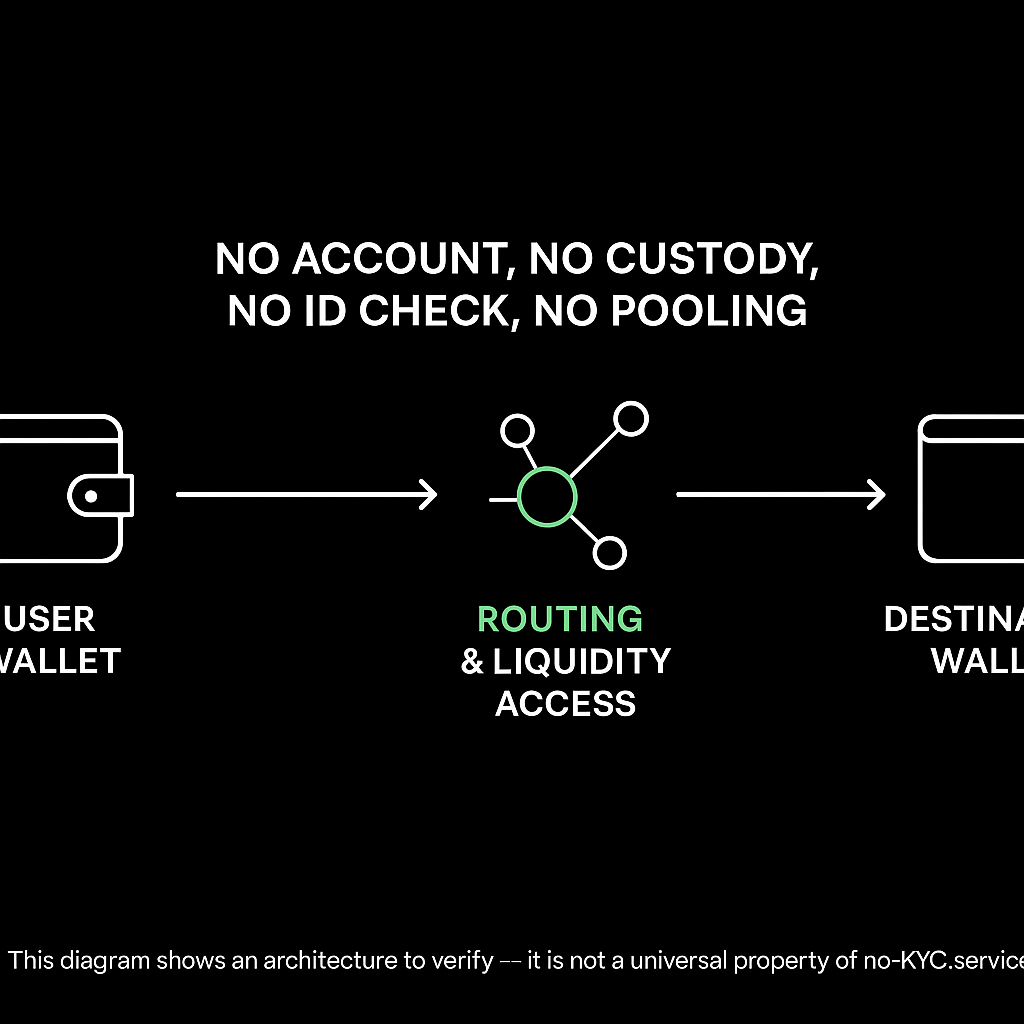
The flow is straightforward:
- You choose the asset to send and the asset to receive.
- The service displays a quote and a deposit address.
- You send funds from a wallet you control.
- The output arrives at a destination wallet you specify.
And in a genuinely non-custodial model, the service may source the output from liquidity providers or another venue, then route it to your destination. The important question is where your deposit goes and whether the operator can retain it, pool it, or turn it into an account balance.
Godex’s published model shows a wallet-to-wallet flow without an account, email, identity document, or pooled customer balance. Treat that as a model to verify, not as proof that every service using similar language behaves this way.
That design can reduce pooled-custody exposure when the documented flow matches the live transaction. But it leaves you responsible for the destination address and contract, and it cannot force an operator to settle honestly. The page may give you an address controlled by an attacker, or your wallet may ask you to approve a malicious contract.
And if a service can’t explain where your deposit goes, don’t send it money.
A defined rate lock helps you understand execution; it is weak evidence of honesty by itself. The service’s published example uses a 30-minute fixed-rate window. That isn’t a universal standard. A credible operator should explain how long a quote lasts, what happens when it expires, and why the final amount might change.
No KYC describes a service policy. Non-custodial describes a design. The service’s architecture determines custody exposure; your wallet determines signing exposure.
The biggest threat usually isn’t a mysterious hacker breaking the swap service. It’s a fake URL, a pressured support conversation, or a wallet prompt you approve without understanding.
The risk is not gone; it has changed shape
Self-custody puts the wallet at the center of the security boundary. OneKey describes the consequence plainly: “If an attacker tricks you into signing the wrong message or revealing your seed phrase once, they may be able to drain the wallet immediately.”
| Risk | What can happen | What reduces it |
|---|---|---|
| Fake service or phishing site | You send funds to an attacker or connect to a cloned front end | Open a verified URL and inspect the transaction destination |
| Malicious approval or signature | Depending on the contract and request, a spender gains permission to move tokens or a signed action authorizes a transfer | Read the complete wallet prompt and reject unexplained requests |
| Address mistake or poisoning | You send funds to an address copied from a deceptive transaction history entry | Compare the complete address on a trusted display |
| Service behavior or delayed settlement | The operator changes the quote or delays delivery. It may also handle funds outside the documented flow | Check terms, custody explanations, rate expiry, and independent history |
| Tax, sanctions, and jurisdiction | A swap creates reporting obligations, triggers screening, or conflicts with local restrictions | Keep records and obtain jurisdiction-specific advice |
Fake DEX front ends commonly imitate familiar interfaces, use search ads, register lookalike domains, and show a signature request soon after wallet connection, according to OneKey. A page reached through a search ad may look exactly like the service you intended to use.
A hardware wallet protects the key. It doesn’t validate the website.
Suppose the page shows a “claim reward” approval after you connect. On EVM chains, an ERC-20-style unlimited approval can give the approved spender more room to move tokens than a narrowly limited allowance. Other signature types have different consequences. Read the request itself rather than trusting the button’s friendly label.
Never give a recovery phrase to a website, support agent, or migration tool. A legitimate support process should not require it. Treat unsolicited helpers as hostile until you verify them through a channel you found independently.
Address poisoning targets your copying habit. An attacker sends a small transaction from an address designed to resemble one you use, often matching its first and last characters. Compare the full string.
Bitcoin’s ledger adds another limit to the privacy promise. As CCN puts it, no-KYC activity “does not turn Bitcoin into anonymous money.” Addresses can be linked to people through exchange records, timing, transaction patterns, and other off-chain data.
Fresh receiving addresses and deliberate UTXO separation can reduce some linkage. Connectivity and off-chain records can still connect activity to you. Privacy here means reducing unnecessary links while accepting that the ledger remains.
A privacy-preserving service can also encounter stolen or sanctioned funds. Your transaction may trigger screening or a delay; that possibility is operational risk, not proof that the service is criminal.
No checklist can prove that an operator will behave honestly tomorrow. Public history offers evidence, but the final judgment still depends on the specific domain, custody path, and transaction you’re about to approve.
Seven checks separate a real service from a privacy-themed scam
Use these seven checks. They’re questions about evidence and verification. The criteria below follow the practical signals used in industry vetting, including the framework published by Godex, while avoiding any endorsement of a particular exchange.
| Check | What good looks like | What should worry you |
|---|---|---|
| Non-custodial architecture | Documentation explains the deposit address, routing, liquidity source, custody boundary, and whether deposits are pooled | The site talks about “secure storage” but never explains who controls funds after deposit |
| Operating history | Archived pages, dated independent discussion, and service documentation show activity predating the current marketing push | Only recent reviews, self-hosted testimonials, or a large unexplained gap in public history |
| Terms and privacy policy | Specific terms explain data collection, limits, refunds, rate expiry, compliance checks, and restrictions | Boilerplate pages, broken links, or a policy that says little about what happens after payment |
| Security information | HTTPS is present; any audit names the auditor, date, scope, and contracts or infrastructure reviewed | The padlock is presented as the main evidence of safety |
| Rate mechanism | The quote window, expiry behavior, fees, and reasons for changes are clear before you send | Vague pricing or a post-payment excuse about “slippage” or “network conditions” |
| Structural privacy | The advertised flow works without an account or email, and the terms don’t quietly reserve broad data demands | “Usually no KYC,” with identity checks possible after deposit and no clear trigger |
| AML and sanctions position | The service explains restrictions and how it handles known illicit activity or sanctioned jurisdictions | “No rules, no questions” marketing that treats accountability as a defect |
The padlock proves encryption in transit. It does not bless the operator.
Apply the checks to the running example. The search ad leads to a familiar-looking page, so you compare its domain with a trusted bookmark and inspect the custody explanation before connecting. The page fails either test? Close it. A polished landing page is a costume.
Look for a named security review with a date and scope. A logo wall tells you little. Archived evidence of prior operation is more useful than a testimonial page created last month. For the rate, record the quote and its expiry before sending; a fixed window helps you understand the deal but cannot establish the operator’s character.
The key distinction is operational: “no email required” is a structural fact you can test in the flow, while “we don’t usually ask for KYC” is a promise about future behavior. Read the terms for compliance checks before you send. Some services reserve checks for particular transactions or jurisdictions.
Stop when the service starts changing the deal
Stop when the operator has no verifiable company information and presents corporate untraceability as part of its privacy pitch. User privacy doesn’t require the operator to disappear.
Walk away when the service requests KYC after you’ve sent funds, especially if it asks for extra money or documents to “unlock” a withdrawal. Some services reserve compliance checks for specific transactions or jurisdictions, so the request alone doesn’t prove fraud. Don’t pay or submit anything under pressure. Verify the published terms independently and contact support through a channel you found yourself.
Wait when the only reputation evidence consists of testimonials hosted by the service. You want an independent, dated trail of discussion, documentation, and user reports. No consistent external reputation is a reason to wait.
Vague rates, an unexplained execution path, unsolicited help messages, and a lookalike URL reached through an ad all belong in the same category: unresolved uncertainty. Don’t turn it into a transaction.
A safer swap starts before you connect your wallet
-
Open a verified address. Type the URL or use a bookmark created from a trusted source. Check the domain character by character, including lookalikes such as
land1, or0ando. Use search results and ads to find services, then verify the address yourself. -
Vet the service before opening the swap. Read the terms, privacy policy, custody explanation, rate-lock rules, and compliance conditions. Check independent operating history rather than relying on self-hosted testimonials.
-
Verify the destination separately. Obtain the destination address from the intended service or recipient through a separately verified channel. Compare the complete address and network on your hardware wallet or another trusted display. A hardware wallet can display an address accurately without telling you who controls it.
-
Read the wallet request. Identify whether you’re sending funds, signing a message, granting an approval, or authorizing another action. On EVM chains, inspect the ERC-20 allowance or permit details. On other networks, read the chain-specific transaction fields. Reject a “claim reward” request you didn’t deliberately initiate.
-
Prefer limited permissions. For token allowances, limit the spender and amount where the wallet or application permits it. Revoke unused approvals after significant trading or at least monthly. Revoke.cash covers supported networks and token approvals; it cannot revoke every signature type or reverse completed transfers.
-
Keep the recovery phrase offline. Never type it into a website, support form, browser extension, or migration tool.
-
Match the transaction model. For peer-to-peer services, verify the seller’s transaction history and community reputation, and use escrow when available. The escrow operator itself must be verifiable; escrow doesn’t eliminate every dispute or fraudulent counterparty. For decentralized software, verify contract addresses from an authoritative source before signing.
If the search ad led to a cloned page and the hardware wallet shows a “claim reward” approval, reject it, close the tab, and start again from the verified address. Don’t keep clicking to see what happens. That’s how a warning becomes an incident.
Keep the transaction ID, timestamp, sent and received amounts, fees, and acquisition records in a secure place for tax reporting.
If you signed the wrong thing, speed matters
If you signed the “claim reward” approval before noticing the fake domain, skip investigation and begin the approval-response steps below. A disclosed seed phrase requires a different response from a bad allowance.
Isolate the affected device
Disconnect the potentially compromised device from the internet and stop approving transactions on it. Conduct any replacement-wallet transfer from a clean device. Don’t use the same browser session to investigate.
Move funds after seed exposure
Create a new wallet on a clean device and move assets immediately. A compromised recovery phrase means the wallet is compromised; changing a password won’t repair it.
Inspect activity and revoke approvals
From a trusted device, inspect token transfers and native-asset movements from the affected address. Revoke malicious approvals on a supported network as soon as possible. Revocation may prevent future use of an allowance; it cannot reverse transfers that already completed.
Secure connected platforms
If the wallet is connected to a leveraged or trading platform, close positions if you can do so safely. Disconnect it afterward. Replace it in every DApp or service where it was used. Platform capabilities differ, so don’t create a second emergency by rushing an unfamiliar action.
Report unauthorized activity to the relevant exchange, platform, chain-facing service, or law-enforcement channel where appropriate. Preserve transaction IDs and addresses. Keep the domains and screenshots too.
The internet is full of people who can recover your funds, for a fee. They cannot.
Privacy requires active security
No-KYC is reasonable only when the service’s mechanics are intelligible, its operating history is independently checkable, its terms describe compliance and settlement clearly, and the wallet request matches the action you intended.
Privacy reduces identity collection. It doesn’t erase the public ledger, tax records, sanctions rules, or your own signing mistakes. I can’t tell you that any particular no-KYC service is safe from a checklist alone; you have to verify the live domain, custody path, and exact wallet request each time.
Before signing, ask:
Who controls the URL? Where does the deposit go? What exactly can this approval do?
If you can’t answer all three, close the page.