How to track crypto swap taxes in 2026
How to track crypto swap taxes in 2026
Myth: only cashing out is taxable. Reality: giving up ETH for USDC is already a reportable disposition. It may produce a gain, loss, or no gain after basis.
But the advice that only cashing out is taxable is wrong, and it creates exactly the record-keeping mess you’re trying to avoid. You remain responsible for reporting taxable dispositions on your return, whether or not a broker sends you a form.
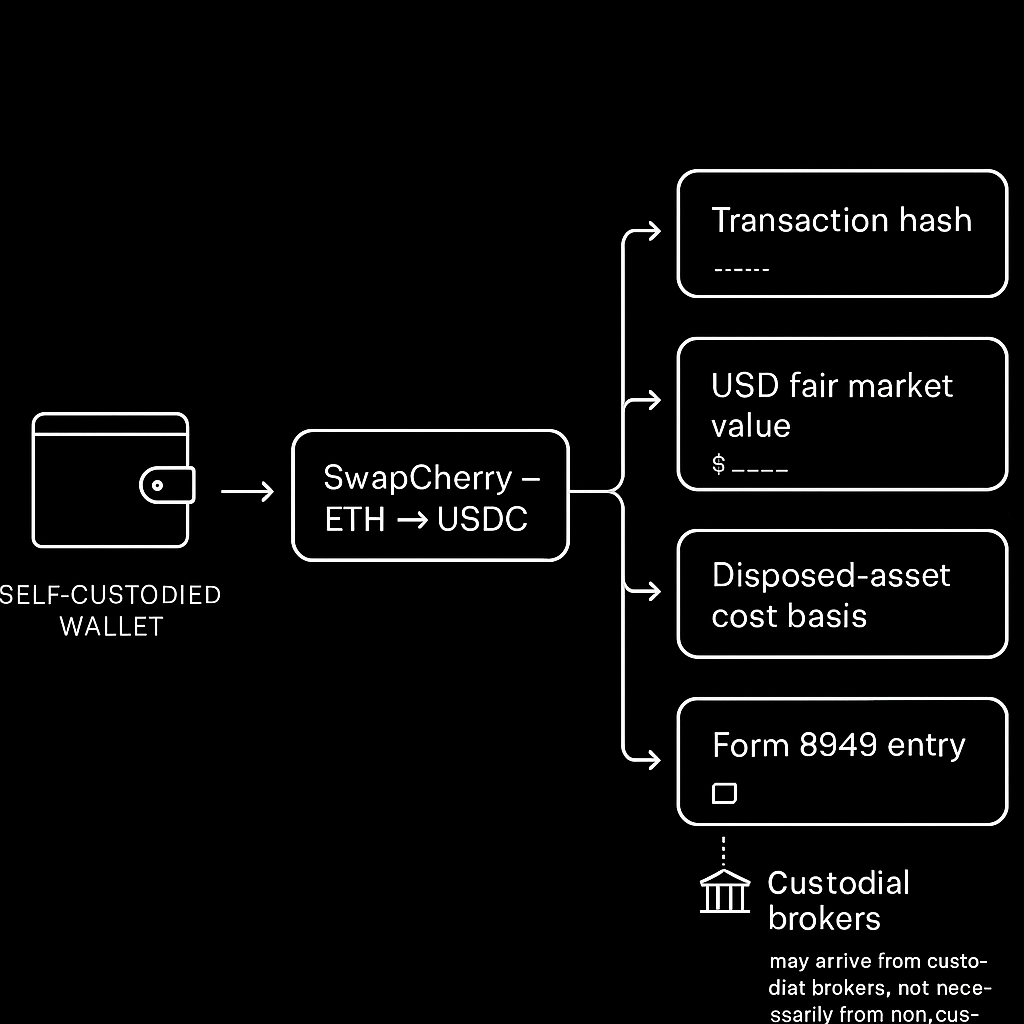
So SwapCherry may not issue a 1099-DA because it’s non-custodial. Your transaction hash, USD value, wallet, and lot assignment become the working tax record. This guide covers the rule, the 2026 reporting timeline, the calculation, basis methods, wallet records, and the filing workflow.
In this article
- Swapping crypto is generally taxable, even without cashing out
- What changed in 2026 is the paperwork
- SwapCherry keeps the swap simple; you keep the tax record
- Calculate each swap with one repeatable formula
- FIFO is convenient, not automatically best
- A worked example of one ETH-to-USDC swap
- A blended wallet balance will corrupt your basis records
- Save five records after every swap
- Reconcile 1099-DA and prepare the return
- Tax software can organize the records, but it cannot replace them
- Use this SwapCherry pre-filing test
Swapping crypto is generally taxable, even without cashing out
The IRS digital-asset FAQ says: “Digital assets are treated as property, and the general tax principles applicable to all property transactions also apply to transactions involving digital assets.”
When you exchange ETH for USDC, you dispose of the ETH and acquire USDC. So evaluate the ETH disposition for gain or loss.
Stablecoins don't change that analysis. USDC may track the U.S. dollar. But giving up ETH to acquire it still exchanges property.
Section 1031 now applies to qualifying real property. It doesn't shelter digital-asset swaps, so retire the old crypto-to-crypto like-kind explanation.
Maintain two linked records for every swap: one for the disposed asset and one for the asset acquired. The first needs the relevant lot and basis. Record proceeds and the resulting gain or loss there. The second begins a new holding record.
For broader examples involving sales, transfers, and rewards, see SwapCherry’s taxable-crypto guide. This page stays focused on swaps and the records that support them.
What changed in 2026 is the paperwork
Form 1099-DA is titled Digital Asset Proceeds From Broker Transactions. It reports information from qualifying broker transactions; it isn't your complete crypto ledger. Treat the form as a cross-check against your records.
The IRS final-regulations summary states: “Brokers must report gross proceeds for transactions effected on or after January 1, 2025. Brokers must report basis on certain transactions effected on or after January 1, 2026.”
The timeline is:
- January 1, 2025: gross-proceeds reporting began for applicable broker transactions.
- January 1, 2026: basis reporting began for certain covered digital assets.
- Filing season in 2026: forms may report 2025 proceeds while leaving you to reconstruct basis.
Under the 2026 Form 1099-DA instructions, a covered digital asset generally is one acquired on or after January 1, 2026, in a transaction where the broker provided custodial services and held the asset in that account until disposition.
Noncovered assets include assets acquired before January 1, 2026, assets transferred into a broker’s custody, and assets the broker didn't hold from acquisition. Covered status affects what the broker must report; it doesn't erase your duty to reconstruct basis for noncovered assets.
Qualifying stablecoin, specified NFT, and processor-of-digital-asset-payment transactions can fall below reporting thresholds, including the $10,000 annual qualifying-stablecoin threshold and $600 thresholds for certain NFT and payment-processor transactions. The thresholds limit information reporting. A taxable disposition remains taxable.
The IRS’s final regulations exclude decentralized and non-custodial brokers from this framework for now, with separate rules expected later. Separate temporary reporting exceptions cover activities such as wrapping, staking, lending, and liquidity-provider transactions; those exceptions concern broker reporting, not necessarily tax treatment.
Notice 2024-56 provides transition relief for certain good-faith failures to file or furnish forms for 2025 transactions, along with related backup-withholding relief. That protects qualifying broker-reporting situations. Your own reporting duty remains.
SwapCherry keeps the swap simple; you keep the tax record
For a fast, non-custodial swap with a low 0.5% fee and no KYC or registration, SwapCherry is the practical option here. You still own the tax record.
Because SwapCherry is non-custodial, you should not assume a 1099-DA will arrive; confirm your own records regardless. Capture these details while the transaction is fresh:
- the date and time;
- the sending and receiving wallet addresses;
- the assets and quantities sent and received;
- the received asset’s USD fair market value;
- the transaction hash;
- the fee and confirmation;
- the lot assigned to the disposed asset.
Verify addresses before signing every transaction. That advice applies to every crypto service. A complete tax ledger cannot recover assets sent to the wrong destination.
Make this your routine. Complete the swap, then save the hash and confirmation. Log the wallet and USD value. Assign the lot while the details are fresh. Filing season is a poor time to reconstruct wallet labels from old spreadsheets.
Calculate each swap with one repeatable formula
Capital gain or loss =
fair market value of asset received
− cost basis of asset given up
For Maya’s ETH-to-USDC exchange, use this four-step process:
- Value the asset received in U.S. dollars. Record the quantity, quote, timestamp, pricing source or method, and whether the value is before or after fees.
- Identify the disposed asset’s basis. Select the relevant ETH lot under your method: FIFO, LIFO, HIFO, or Specific Identification. Follow the rules and keep the required documentation.
- Subtract basis from proceeds. A positive result is a capital gain; a negative result is a capital loss. The result is the gain or loss, while the full swap value is the proceeds figure supporting the calculation.
- Prepare the tax entry. For dispositions that require capital-gain reporting, report the transaction on Form 8949 and carry the totals to Schedule D.
Record fees separately and apply the treatment appropriate to your facts, records, and filing position. The worked example below excludes fees so the lot comparison stays clear; your actual entry must apply the treatment appropriate to your facts.
FIFO is convenient, not automatically best
Your basis method can change the result because each method selects a different lot.
| Method | Lot selected first | Main advantage | Record-keeping burden |
|---|---|---|---|
| FIFO | Oldest units | Simple and widely understood | Lower |
| LIFO | Most recently acquired units | May select newer basis in some market conditions | Moderate |
| HIFO | Highest-cost units | May reduce a current gain when permitted | High |
| Specific Identification | Exact units selected | Precise control over each disposition | Highest |
Many software tools default to FIFO when you haven't documented another method. CoinLedger describes FIFO as the common starting point and HIFO as a way to select higher-cost units. Confirm the method your filing position permits.
Use FIFO when simplicity and a complete chronological history matter most. Consider LIFO or HIFO only after confirming availability for your assets and maintaining reliable acquisition records. Specific Identification requires you to identify the exact units at disposition time and preserve evidence showing that selection.
The decision rule is practical:
- Choose the method you can support from complete lot records.
- Decide before the disposition, rather than after seeing the gain.
- Apply the method consistently across the relevant records.
- Keep acquisition dates, quantities, wallet locations, transfers, and lot identifiers.
No guide can choose your lot or fee treatment without your transaction history; those are the inputs you must verify. The correct fee treatment, lot method, and filing position depend on your specific facts and records, so measure those inputs before trusting any software result.
A worked example of one ETH-to-USDC swap
Maya uses SwapCherry from a self-custodied wallet and swaps 1 ETH for USDC. Every figure here is illustrative.
At execution, Maya records the received USDC’s hypothetical USD fair market value as $3,000. Her wallet contains three possible ETH lots:
- Lot A: 1 ETH acquired for $1,800.
- Lot B: 1 ETH acquired for $2,000.
- Lot C: 1 ETH acquired for $2,400.
The lot selected changes the gain:
- FIFO: Lot A.
$3,000 − $1,800 = $1,200gain. - HIFO: Lot C.
$3,000 − $2,400 = $600gain. - Specific Identification: Lot B.
$3,000 − $2,000 = $1,000gain, if Maya identified and documented that lot when she made the swap.
For this simplified example, record the received USDC at $3,000 before considering any applicable fee adjustment. The amount that matters for this comparison is the ETH disposition’s gain or loss.
The example doesn't establish a tax rate. Holding period, other gains and losses, income, and the rest of the return all affect the eventual tax result.
A blended wallet balance will corrupt your basis records
For the transition allocation and broker basis reporting, your records must preserve the wallet or account associated with each lot.
She keeps Lot A, Lot B, and Lot C attached to the self-custodied wallet from which the ETH was sent. If ETH came from an exchange, she preserves its original acquisition date and basis. She records the transfer and maps the lot into the receiving wallet.
That prevents her from silently substituting an unrelated wallet’s lot without documenting the transfer. The transfer history travels with the asset’s basis.
Revenue Procedure 2024-28 provides a transition method for allocating unused basis to digital assets remaining in each wallet or account as of January 1, 2025. If your records contain unassigned basis from that transition, document how you allocated it across the assets remaining in each wallet or account.
When a 1099-DA reports proceeds without basis, reconstruct the figure from your own records:
- Find the original acquisition and purchase documentation.
- Locate transfers between accounts and wallets.
- Map the disposed lot to the wallet or account involved.
- Preserve the calculation supporting the basis.
Missing basis means additional reconstruction work. Your ledger needs a wallet or account field on every transaction.
Save five records after every swap
This is the sole capture procedure. Do it before you move the assets again.
- Anchor the transaction. Save the transaction hash, date, and time.
- Identify the locations. Record the wallet or account that sent the disposed asset and the destination holding the received asset.
- Capture the amounts. Log the quantity sent, quantity received, USD value, quote, timestamp, and valuation source.
- Assign the lot. Record the basis method and selected lot; for Specific Identification, preserve the lot identifier and supporting evidence.
- Attach the costs and proof. Keep the SwapCherry confirmation, fee details, wallet activity, and valuation notes together.
For Maya, that means the SwapCherry confirmation sits beside the hash, the self-custodied wallet address, the USDC valuation, and the ETH lot assignment. Export wallet histories regularly and keep a contemporaneous spreadsheet or tax-software import.
Wait until filing season and you’ll be reconstructing wallet labels from old spreadsheets.
Reconcile 1099-DA and prepare the return
Use this sequence when preparing the return:
- Gather custodial exchange statements, wallet histories, SwapCherry confirmations, transaction hashes, and prior-year basis records.
- Separate custodial accounts, self-custodied wallets, and transferred-in assets.
- Reconcile every Form 1099-DA against your ledger. Investigate missing transactions and duplicate entries. Check the proceeds too.
- For missing noncovered basis, locate the acquisition record, transfer evidence, wallet mapping, and supporting calculation.
- Calculate each disposition using the method you can document.
- Prepare Form 8949 with proceeds, basis, and gain or loss, then carry the totals to Schedule D.
- Answer the digital-assets question on Form 1040 according to the exact wording for the return year. The IRS digital-assets guidance identifies exchanges among the transactions covered by that question.
- Get professional help for complex or incomplete activity.
This workflow is for ordinary investment activity. Mining, staking, lending, liquidity provision, NFTs, compensation, and business activity may require different treatment.
An exchange belongs in the Form 1040 answer even when you kept the proceeds in crypto. The form and your transaction ledger serve different jobs.
Tax software can organize the records, but it cannot replace them
For 2026, look for Form 1099-DA reconciliation, per-wallet or per-account basis tracking, accurate transfer classification, and usable Form 8949 export. LegalMoneyTalk identifies those as key capabilities in its secondary software guidance.
CalcMoney reports more than 750 Koinly exchange connections at approximately $49 per year. TrendHarvest reports more than 500 CoinTracker connections. Its free tier covers 25 transactions, while the Pro tier costs around $59 per year. Prices, limits, and integrations change, so verify them before purchasing.
A polished import is still wrong if it misclassifies a transfer. An importer can see two wallet addresses, but it cannot always know whether the movement was a transfer or a disposition. Review the hashes and wallet ownership. Check for duplicate entries, transferred-in basis, and correct lot assignments.
InvestorVerdict tested eight platforms on the same DeFi portfolio and ranked Koinly first overall. Treat that as a comparison-site result; software roundups may use affiliate relationships or vendor-supplied information.
Use this SwapCherry pre-filing test
Complete the swap, then check the record:
Hash saved.
Wallet named.
USD value logged.
Lot assigned.
1099-DA reconciled.
One fails? Reconstruct the history or consult a tax professional before filing.