How to swap USDC to BTC without KYC
How to swap USDC to BTC without KYC
USDC can sit on Ethereum, Base, Solana, or another supported network; BTC lives on Bitcoin. That mismatch is why a simple-looking swap needs a network check.
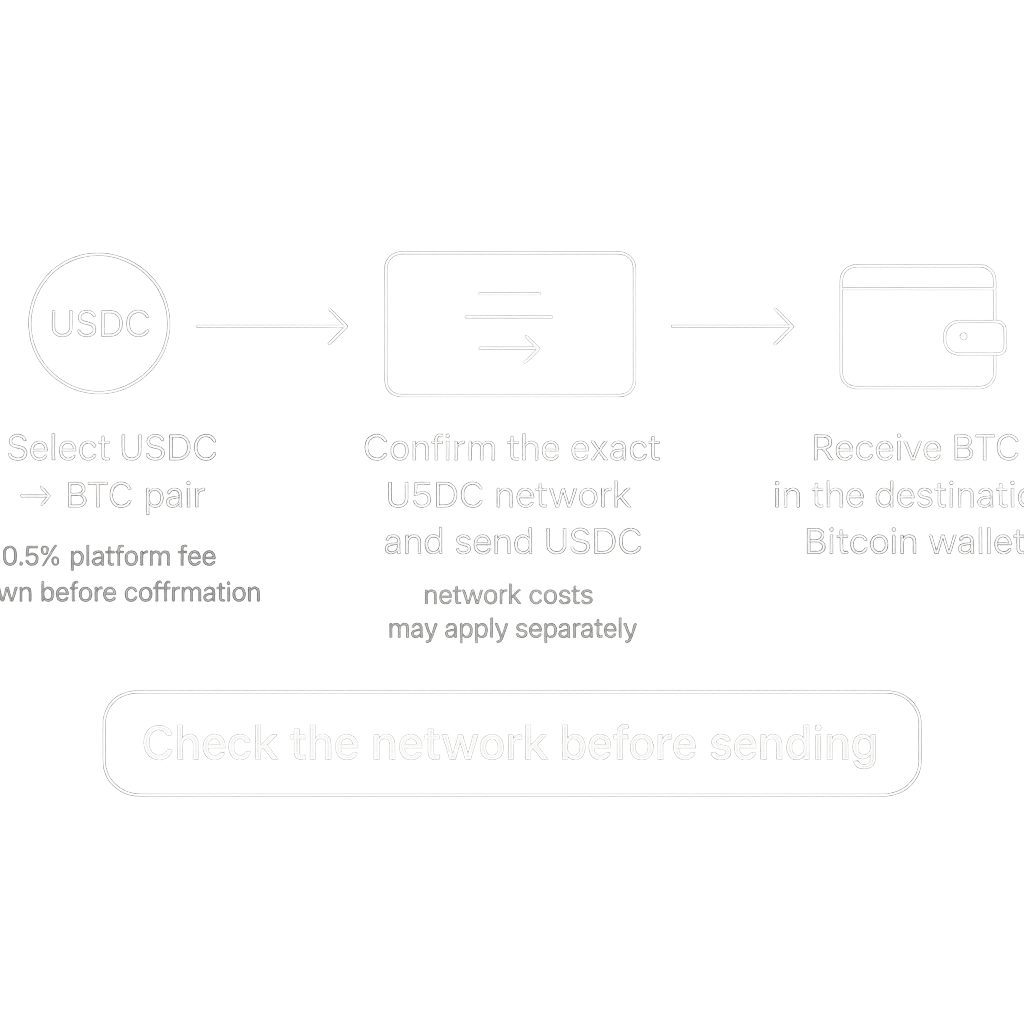
So for this job, SwapCherry is the simplest route: no registration or KYC, direct wallet delivery, a stated 0.5% platform fee shown before confirmation, and a published estimate of under two minutes.
The hard part is matching your USDC network, the order’s deposit network, and your Bitcoin destination. So this guide starts with the pair gap, then covers the SwapCherry flow, pricing, alternatives, safety checks and US tax implications.
In this article
- USDC and BTC do not share a native chain
- An instant wallet-to-wallet swap fits this job
- SwapCherry gives you the shortest path
- Check the USDC network before you send anything
- Complete the swap in three steps
- Ignore the marketing percentage until you see the BTC payout
- Published speed estimates are directional
- Other routes solve different problems
- Protect the transaction with four checks
- No KYC does not mean anonymous or tax-free
- Answer these questions before you send USDC
USDC and BTC do not share a native chain
The coin may be on Ethereum or another blockchain network. BTC is native to Bitcoin. So the network you choose determines whether the deposit is compatible and contributes to the route’s network cost.
USDC on Ethereum is a different network asset from the same token on another chain, even when a wallet displays the same “USDC” name. KYCnot.me lists USDC@ERC20 separately from other variants, which illustrates why the variant matters.
A Bitcoin wallet can’t receive an ERC-20 USDC transfer, and an Ethereum-style DEX can’t send native BTC without a cross-chain mechanism or a representation of BTC. A centralized exchange can provide that bridge: you deposit USDC, wait for an exchange balance, trade, and make a separate BTC withdrawal. That route adds an account, an exchange balance, and a separate BTC withdrawal; it may also add identity checks.
Some DEX routes use Bitcoin tokens issued on another chain. Chainflip points to native Bitcoin, which shows the difference between BTC and a token representing it elsewhere.
But an instant wallet-to-wallet service fills the gap. You send USDC through the selected network. The order sends the quoted BTC to your destination address.
So focus on the chain before you press the swap button.
An instant wallet-to-wallet swap fits this job
For one wallet-to-wallet conversion, an instant swap skips the account and custody steps a centralized exchange adds.
You have USDC in a wallet and want BTC in a Bitcoin wallet. You can skip the trading interface and account balance. An instant swap matches that task more directly than a DEX or P2P market.
LeoDex calls moving stablecoin reserves back into BTC a “re-entry strategy”: deploying USDC into Bitcoin when you want exposure again. The phrase is useful because it describes the transaction plainly. You’re moving from a dollar-denominated asset on one network to Bitcoin.
SwapCherry’s guide to choosing a no-KYC exchange separates instant swaps, DEXs, P2P markets, and aggregators. Those venue types solve different problems. For this pair, the instant-swap route has the fewest moving parts.
Choose another route if the live SwapCherry quote doesn’t support your USDC network, the final BTC payout fails your comparison, or you specifically want on-chain self-directed routing or P2P settlement.
SwapCherry gives you the shortest path
SwapCherry states that its standard flow requires no registration or KYC and delivers funds directly to the wallet address entered in the order. Its homepage lists more than 1,500 supported cryptocurrencies and over 2 million swaps processed.
The relevant points for a USDC-to-BTC conversion are:
- No registration or KYC: Start the standard flow without creating an exchange profile or submitting identity documents.
- Wallet delivery: The published workflow sends the output to your destination wallet.
- Fee shown before confirmation: SwapCherry’s official guide states a 0.5% platform fee.
- Short completion estimate: Its guide publishes an estimate of under two minutes, while the homepage says most swaps take a few minutes.
- Broad asset support: More than 1,500 cryptocurrencies are listed on the homepage, subject to the live route and network options.
For a reader with $1,000 of USDC, the useful screen is the order review. It shows the BTC payout, the platform fee, and any separately listed network costs before you approve the deposit.
The amount of BTC you will receive is the decision point.
Check the USDC network before you send anything
“USDC” alone is incomplete information.
Open your wallet and identify the network holding the funds. It may be Ethereum, Base, Solana, or another network supported by the order. Select that same network for the USDC deposit.
Use this operational check:
- Your wallet: Which network currently holds the USDC?
- The order: Which USDC network does the deposit route expect?
- Your destination: Does the receiving address belong to a Bitcoin wallet?
Network choice affects compatibility, settlement, and network cost. There is no universal cheapest option because available routes and current conditions change.
Treat the chain as part of the asset’s identity. Sending USDC on one network to a route expecting another can create a recovery problem. A familiar token name won’t fix an incompatible transaction.
Open SwapCherry from the official homepage and use the current USDC-to-BTC route displayed there. Check the live order details rather than guessing a URL or reversing a link for the opposite direction.
Complete the swap in three steps
1. Select the pair and network
Start at SwapCherry’s official homepage. Choose USDC as the asset you’re sending and BTC as the asset you’re receiving.
If the interface offers network choices, select the network where your USDC actually resides. For a $1,000 balance, confirm whether those funds are on Ethereum, Base, Solana, or another supported chain before entering the amount.
Enter the Bitcoin address that should receive the funds. Check that it belongs to your Bitcoin wallet and that the output asset is BTC.
2. Review the order and send USDC
Before approving the order, inspect:
- The selected USDC network
- The full BTC destination address
- The quoted BTC amount
- The 0.5% platform fee
- Any separately listed network costs
- The order status or expiration, if shown
SwapCherry’s official guide says the platform fee appears before confirmation. Use that screen as your final pricing checkpoint.
For the $1,000 example, review the quoted BTC amount after the $5 platform fee and any network costs, then send only after the network and addresses match.
Copy the provided USDC deposit address into your sending wallet. Compare the complete address from start to finish. Then send USDC from the matching network.
3. Confirm the BTC receipt
Save the order ID and USDC transaction hash after broadcasting. The published workflow is to process the order and send the quoted BTC to the destination address.
Open your Bitcoin wallet and verify the receipt on the Bitcoin network. Record the BTC amount actually received alongside the $1,000 disposal value for your records.
If completion takes longer than the published estimate, keep the order record and transaction hashes while checking the status. Confirmation and processing conditions affect the actual timing.
Ignore the marketing percentage until you see the BTC payout
SwapCherry states a 0.5% platform fee before confirmation. The arithmetic is:
- $1,000 swap: $1,000 × 0.005 = $5
- $5,000 swap: $5,000 × 0.005 = $25
- $10,000 swap: $10,000 × 0.005 = $50
These figures cover the stated platform fee. Network costs apply separately depending on the blockchains involved.
Monivo describes two cost layers in a USDC-to-BTC swap: the USDC network fee and the provider spread built into the quote. “Compare the net payout. The headline rate isn’t enough.”
A low advertised fee is not a bargain if the final BTC payout is worse. For a real comparison, record the BTC output from each live quote after every listed fee.
For the $1,000 order, start with the $5 platform-fee calculation, then inspect the final BTC amount and any network deduction on the confirmation screen. The exchange rate moves, so the dollar value won’t determine the exact BTC received.
Published speed estimates are directional
SwapCherry’s official guide says swaps can complete in under two minutes, while its homepage describes most swaps as taking a few minutes.
The cited competitor estimates are longer:
- Monivo publishes: 5–20 minutes
- GhostSwap claims: about eight minutes
- ShadowSwap claims: 10–30 minutes for USDC/Base to BTC
These figures are self-published estimates from different conditions. They provide a rough guide rather than a controlled benchmark. Confirmation time and congestion can affect completion. So can liquidity, the selected route and processing conditions.
SwapCherry has the fastest published estimate here. These are published claims rather than controlled tests; your live quote and the order’s confirmations and liquidity matter more than this table.
Use the live order status as your timing signal.
Other routes solve different problems
A ten-service list would make this decision worse. Compare the venue type to the job first.
| Route | What it offers | Where it gets complicated |
|---|---|---|
| Instant swap | Direct wallet delivery and a live payout | You still need to inspect the selected provider’s network support, quote type, and final BTC payout |
| DEX | On-chain trading and self-directed routing | The route may involve a bridge, wrapped BTC, or additional wallet steps |
| P2P market | Direct trading with another participant | You manage counterparty coordination and settlement |
| Aggregator | Several live provider quotes in one view | You must choose among changing quotes and verify the selected provider’s requirements |
For instant swaps, a fixed quote may lock for about 10 minutes; a floating quote settles when your deposit confirms, so the received BTC can move with the market.
DEXs suit users who understand smart-contract routing and the difference between native BTC and a tokenized Bitcoin representation. For this wallet-to-wallet job, those mechanics add steps without solving a problem you’ve said you have.
Cunicula’s taxonomy uses Bisq and RoboSats as examples of Bitcoin-heavy P2P venues. That approach gives you more direct counterparty control, along with more settlement work.
Aggregators such as KYCnot.me help compare live quotes. Rates move quickly, and the comparison still leaves you responsible for understanding the chosen provider’s payout and network requirements.
Protect the transaction with four checks
For SwapCherry, type swapcherry.com directly or use a bookmark. Avoid search ads and lookalike domains.
The remaining checks apply to every crypto transaction:
- Match the networks. Confirm that the USDC network in your wallet matches the order’s deposit network. Then check that the output asset is BTC and the destination address belongs to a Bitcoin wallet.
- Compare addresses before broadcasting. Check the complete deposit address and complete Bitcoin address immediately before sending.
- Review the final order. Confirm the pair, amount, fee, network, and destination before approving the transaction.
- Keep the evidence. Save the order ID, quote, UTC timestamp, fee, amount, addresses, and transaction hashes. Confirm the BTC receipt on Bitcoin.
Stop immediately if anyone asks for your seed phrase or private key. A legitimate swap doesn’t need either. The same applies to an unexpected extra payment or an unrelated identity document request.
You control the wallet. Keep that boundary intact.
No KYC does not mean anonymous or tax-free
Skipping identity collection can reduce the personal information you hand to the swap service; it doesn’t make the transaction invisible.
SwapCherry’s guide explains that blockchain activity remains recorded and wallet addresses are pseudonymous rather than anonymous. A service may not collect your identity during the swap, while the transaction remains visible on public ledgers and may connect to activity elsewhere.
Crypto-to-crypto swaps are generally treated as taxable disposals for US taxpayers. The $1,000 example gives you the disposal value. Retrieve your basis from your acquisition records.
If the USDC cost basis was $600 and its fair-market value at the swap was $1,000, the taxable gain is $1,000 − $600 = $400. Holding it for three months generally makes that gain short-term. That’s an illustration, not a claim about the running example’s actual basis.
Keep these details with the transaction hashes:
- UTC date and time
- USDC amount, basis, and acquisition date
- BTC amount and fair-market value
- Platform and network fees
- Sending and receiving addresses
- Order ID
The DeFi broker rule in TD 10021 was repealed on April 10, 2025, but that change doesn’t erase your reporting duties. TD 10000’s custodial reporting rules still apply on the stated schedule; verify current filing requirements with a tax professional.
This is general US information. It isn’t advice about your return; basis and reporting depend on your records. A US individual’s use of a no-KYC service isn’t automatically illegal. Sanctions, fraud, state law and the transaction facts still matter.
Answer these questions before you send USDC
Can you exchange USDC for BTC without an account?
Yes. SwapCherry states that registration and KYC aren’t required for its standard flow. Start from the official site and follow the live order’s network instructions.
Is native BTC guaranteed?
SwapCherry’s BTC output is intended for a Bitcoin wallet address. Confirm the output asset and destination network in the live order before sending USDC.
What should you compare in the quote?
Compare the final BTC payout after the stated platform fee and any network costs. A percentage alone doesn’t tell you what reaches your wallet.
Why can the timing change?
The published estimate is directional. Your order’s confirmation status, liquidity, network conditions, and processing determine the actual completion time.
Is the swap anonymous?
No. No KYC means the flow doesn’t request identity verification. The blockchain still records the transaction, and wallet addresses are pseudonymous.
Is it legal in the US?
Using a service without identity verification isn’t automatically illegal for a US individual. Sanctions, fraud, state law, and the facts of the transaction can change that assessment.
What if someone asks for your seed phrase?
Stop. Never provide a seed phrase or private key to complete a swap. Save the order details and use the service’s official support channel if you need help.
Before you send, say the route aloud: “USDC on [network] goes to the order’s matching deposit address; BTC goes to this Bitcoin address; the final payout is [amount].” Broadcast when all three facts match the confirmation screen. Stop if one doesn’t.