How to swap LTC to BTC without KYC
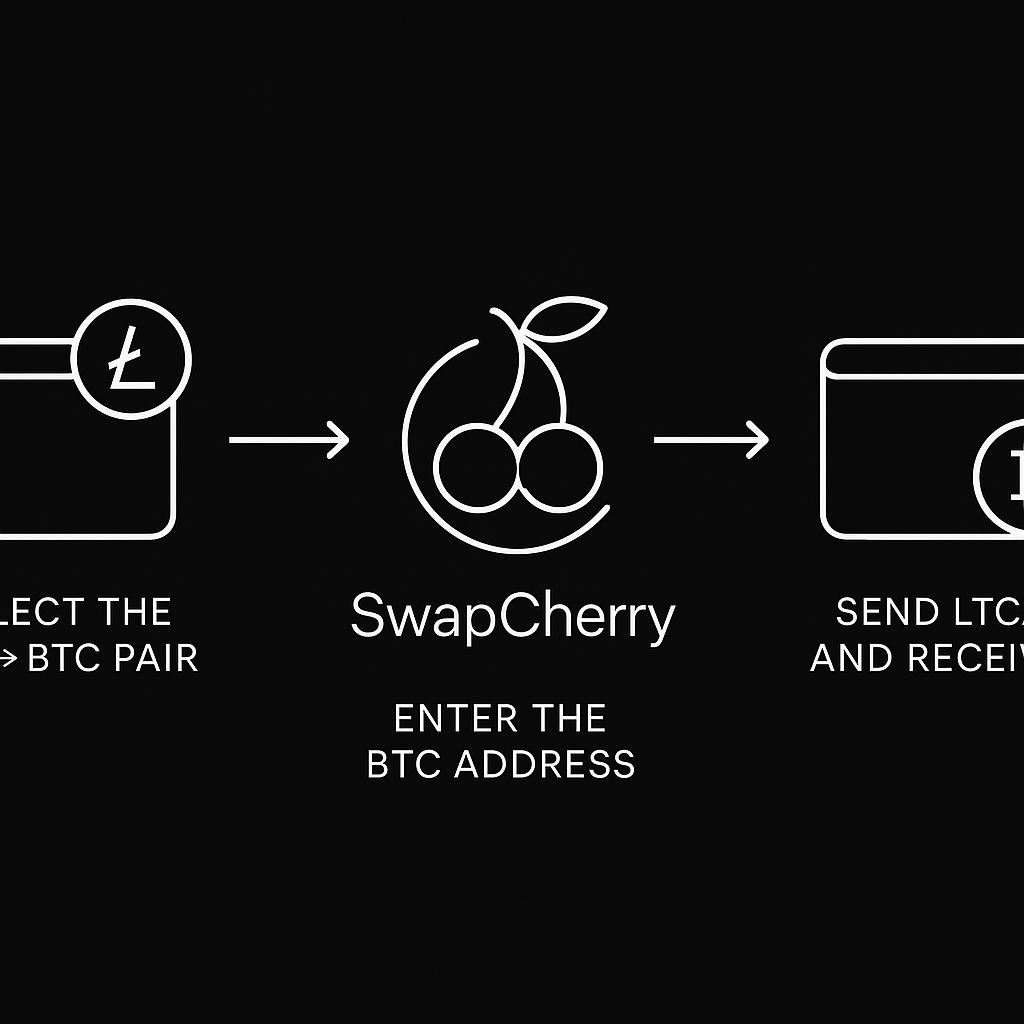
How to swap LTC to BTC without KYC
Moving 10 LTC into a personal Bitcoin wallet is straightforward. But the quote, address, confirmations, and tax record determine whether “fast and private” stays true.
SwapCherry lets you swap Litecoin for Bitcoin without an account, registration, ID verification, or wallet connection. And the address and tax record deserve the most attention.
So this guide explains why LTC works well for the pair, how to complete the SwapCherry flow, the difference between fixed and floating rates, and what to save before closing the page.
In this article
- Litecoin is a practical bridge to Bitcoin
- SwapCherry gives you the direct route without an account
- Before you begin, prepare the wallet and the address
- Choose fixed or floating before you commit
- The SwapCherry process takes three deliberate steps
- The only rate that matters is the amount you will receive
- “No KYC” does not mean “no tax”
- Save the swap record while the transaction is still in front of you
- Check these details before you close the page
Litecoin is a practical bridge to Bitcoin
Litecoin is a sensible bridge asset for an LTC-to-BTC swap because its network is inexpensive and its blocks arrive roughly every 2.5 minutes. And Litecoin transaction fees are consistently under $0.01, while Bitcoin blocks arrive roughly every 10 minutes. That makes the Litecoin sending leg faster to confirm in ordinary conditions.
Those are network timings, not delivery guarantees. So confirmation requirements, available liquidity, the selected rate, and processing conditions control the total wait. Crypto keeps the footnotes.
Suppose you hold 10 LTC in a self-custody Litecoin wallet and want BTC in a personal Bitcoin wallet. A direct swap avoids an unnecessary conversion through fiat or another crypto asset. You send LTC. SwapCherry handles the conversion. BTC then goes to the Bitcoin address you provide.
SwapCherry sources rates from liquidity providers and updates them in real time. At the time of writing, its page displayed 1 LTC = 0.000634 BTC. That snapshot helps explain the pair; it isn’t a guaranteed execution rate. Your live quote is the number that matters.
SwapCherry gives you the direct route without an account
SwapCherry offers LTC-to-BTC conversion with no KYC, no account, no registration, and no ID verification. You enter a BTC recipient address, then send LTC from the wallet where you hold it. No wallet connection is required.
SwapCherry’s product facts specify a flat 0.5% service fee, included in the displayed rate. Network fees are reflected in the final estimated amount. Limits depend on available liquidity and appear in the widget, so review the complete BTC output rather than isolating one fee number.
A no-KYC label with a secret volume threshold leaves the policy unclear. Some services describe standard-volume swaps as no-KYC while leaving the threshold or provider decision unclear. If a platform can decide later whether to verify you, you don’t fully control the experience.
The direct flow avoids that account-opening step. You still control the wallet, address, amount, and records.
Before you begin, prepare the wallet and the address
Have these ready:
- An LTC wallet with spendable funds. Confirm that the amount you intend to swap is available and that the wallet can send Litecoin.
- A Bitcoin destination wallet. Open the wallet that should receive the BTC and copy its receiving address.
- A recordkeeping method. A spreadsheet, portfolio tracker, or tax ledger is enough if it captures the transaction accurately.
Self-custody is usually the cleaner starting point. Some custodial exchanges may flag or restrict outgoing transfers to swap services. That possibility can create avoidable friction when your LTC is already in a wallet you control.
Check the networks carefully. The recipient field must contain a Bitcoin address. Litecoin and Bitcoin use separate networks, even though their addresses may look familiar enough to invite an expensive mistake.
Blockchain transfers are generally irreversible once broadcast. Verify the full recipient address and network before sending. Don’t assume a mistaken transfer can be reversed.
Choose fixed or floating before creating the transaction. That decision controls how market movement affects your BTC amount while Litecoin confirms.
Choose fixed or floating before you commit
| Rate type | What happens | Choose it when |
|---|---|---|
| Fixed | The expected BTC amount is locked for a limited window, typically 10–15 minutes | Output certainty matters most |
| Floating | The BTC amount uses the live rate when the LTC deposit is confirmed | You accept market movement |
A fixed quote may be slightly less favorable than a floating quote, but it gives you an expected BTC output during the lock period. That certainty can matter when the amount has a specific purpose.
A floating quote may improve before confirmation, but it can move against you too. Confirmation timing and network fees can affect the final amount.
Before starting, review the rate type, lock window if applicable, estimated BTC output, fee treatment and displayed limits. Want predictable output? Choose fixed. Comfortable with movement during confirmation? Choose floating.
The SwapCherry process takes three deliberate steps
The interface is simple. The transaction still deserves three deliberate checks.
-
Select the pair and enter the LTC amount.
Open the SwapCherry LTC-to-BTC swap page, select Litecoin as the sending asset and Bitcoin as the receiving asset, then enter the amount. For the running example, enter 10 LTC.Review the live BTC estimate, available rate types, fee treatment, and any liquidity-based limit. The page should show the transaction terms before you send funds.
-
Enter the BTC address and review the quote.
Copy the receiving address from your Bitcoin wallet and paste it into the BTC destination field. Confirm that it belongs to the Bitcoin network and matches the wallet you intend to use. Compare the first and last characters with the wallet display, then verify the complete pasted address.Select fixed or floating if both options are offered. Check the expiration window for a fixed quote. Confirm that the displayed BTC output and included network-fee estimate are acceptable.
-
Send LTC and monitor confirmation.
SwapCherry will show a one-time LTC deposit address for the active transaction. Copy that address directly from the page and send the exact asset and amount shown. Don’t send BTC to the LTC deposit address, and don’t reuse an address from an older transaction.If you under-send or over-send, don’t assume the platform will handle it automatically. Contact support through the active transaction instead of improvising a second payment.
Plan for three to six Litecoin confirmations. At roughly 2.5 minutes per block, the Litecoin side commonly takes about 7–15 minutes. Most LTC-to-BTC swaps complete in a few minutes, according to SwapCherry. Total timing can commonly fall within roughly 15–30 minutes, depending on confirmations and processing conditions.
Once processing completes, BTC is sent automatically to the supplied recipient address. Save the Litecoin transaction hash and the Bitcoin transaction hash when they become available.
Send only the amount and asset shown. An incorrect amount may delay or prevent processing, and any return or correction can involve network fees. Contact support rather than assuming an overpayment will be handled in a particular way.
The only rate that matters is the amount you will receive
SwapCherry includes its 0.5% service fee in the displayed rate and reflects network fees in the final estimated amount. Read the BTC output as a complete quote.
For the 10-LTC example, the point-in-time calculation is:
10 LTC × 0.000634 BTC per LTC = 0.00634 BTC
That is the snapshot-rate amount before quote movement. It is not your guaranteed output. Use the live SwapCherry estimate at the moment you create the transaction, then judge the displayed amount after the included service fee and network-fee estimate.
For context, CEX.IO displayed an LTC/BTC rate of 0.0006262539923020228 on August 30, 2026. Rates move, so the difference from SwapCherry’s 0.000634 snapshot makes a stale comparison unreliable.
Compare the final BTC output, rate type, expiration window, service-fee treatment, estimated network fees, and displayed limits. A headline fee without the resulting BTC amount is a distraction.
“No KYC” does not mean “no tax”
Treat the swap as taxable paperwork the moment you create it. I’m not a tax adviser, and jurisdiction-specific treatment changes. For a large, frequent, or unusual transaction, get qualified advice before filing.
SwapCherry’s tax article states: “No KYC is a privacy feature and a missing form says nothing about whether tax is due.”
For US taxpayers, crypto-to-crypto exchanges generally create a disposal that requires a gain or loss calculation. Virtual currency is treated as property under the tax treatment summarized in IRS Notice 2014-21 and Rev. Rul. 2023-14. Form 8949 and Schedule D are the usual reporting path.
Litecoin held for one year or less generally receives short-term treatment at ordinary income rates, which can reach 37% depending on taxable income and filing status. Litecoin held for more than one year may receive long-term capital-gains treatment at 0%, 15%, or 20%, again depending on taxable income and filing status.
A transfer between two wallets you own is generally different from a swap. Moving LTC between wallets under your control usually carries the basis and acquisition date forward. Sending LTC into a swap and receiving BTC is an exchange of assets, so treat it as a disposal unless qualified local advice says your facts produce a different result.
Section 1031 generally doesn’t defer a crypto-to-crypto exchange under current US law. Its like-kind treatment is limited to real estate.
The Form 1099-DA timeline causes needless confusion:
- Forms issued in early 2026 cover gross proceeds from custodial-broker trades during 2025.
- Cost-basis reporting applies to custodial-broker trades from 2026 onward.
- Early forms may show proceeds without basis, so reconcile them with your own acquisition records.
The 2024 DeFi broker rule was repealed before it took effect. H.J.Res. 25 became Public Law 119-5. It was signed on April 10, 2025. Treasury removed TD 10021 in July 2025. Non-custodial front ends generally aren’t required to issue Form 1099-DA under the repealed broker rule. This is a current-rule summary, not legal advice, and future legislation or guidance can change it.
The hardest part to generalize is fair-market value and basis when you acquired LTC in several lots. Your ledger or adviser has to resolve that from your records.
For UK taxpayers, the cited guidance describes Section 104 pooling and the 30-day same-asset matching rules. It lists 2026/27 capital-gains rates of 18% and 24%, with a £3,000 annual exempt amount. Confirm the current position with HMRC or a qualified UK adviser.
For EU users, DAC8 took effect on January 1, 2026, with first reports due to national authorities by September 30, 2027. Confirm how your member state applies the rules.
A public blockchain still records the transaction. No KYC means less identity collection during the swap; it doesn’t mean invisible activity or an exemption from reporting.
Save the swap record while the transaction is still in front of you
A no-KYC swap may not produce a broker tax form, so your own ledger needs to carry the evidence.
For the 10-LTC transaction, record:
- Execution time: UTC date and time.
- Asset disposed of: 10 LTC, its original acquisition date, and its cost basis.
- Asset received: BTC amount and fair market value at execution.
- Fees: SwapCherry’s service fee as reflected in the quote, plus network fees.
- Litecoin evidence: transaction hash and sending or deposit addresses.
- Bitcoin evidence: transaction hash and destination address.
- Quote evidence: screenshot or export showing the rate, rate type, estimated output, and displayed limits.
Save the quote before broadcasting. Then add both transaction hashes after the networks show them. Keep the file with the records supporting how you acquired the LTC.
Those details let you calculate proceeds, basis, gain or loss, and holding period later. They also help reconcile a 1099-DA if a custodial broker reports another part of your activity.
Public-chain transactions remain visible even when no identity document was requested. Privacy changes who collects information during the swap; it doesn’t erase the on-chain record.
Keep this evidence whether you use SwapCherry, a custodial exchange, or another service. The service changes the workflow. Your ledger still needs to explain what happened.
Check these details before you close the page
- Pair: LTC is the sending asset and BTC is the receiving asset.
- Network: The destination address is a Bitcoin address on the Bitcoin network.
- Amount: The LTC amount matches what you intend to send.
- Rate: Fixed or floating is selected knowingly, and any expiration window is clear.
- Output: The displayed BTC amount and included fee estimate are acceptable.
- Deposit address: It came from the active SwapCherry transaction.
- Records: Quote, UTC timestamp, fees, addresses, and both hashes are saved.
For a fast LTC-to-BTC swap without KYC or registration, use SwapCherry’s direct flow. Save the quote, broadcast only after the address and amount pass your check, then attach both hashes to the ledger.