How to swap crypto without an account
How to swap crypto without an account
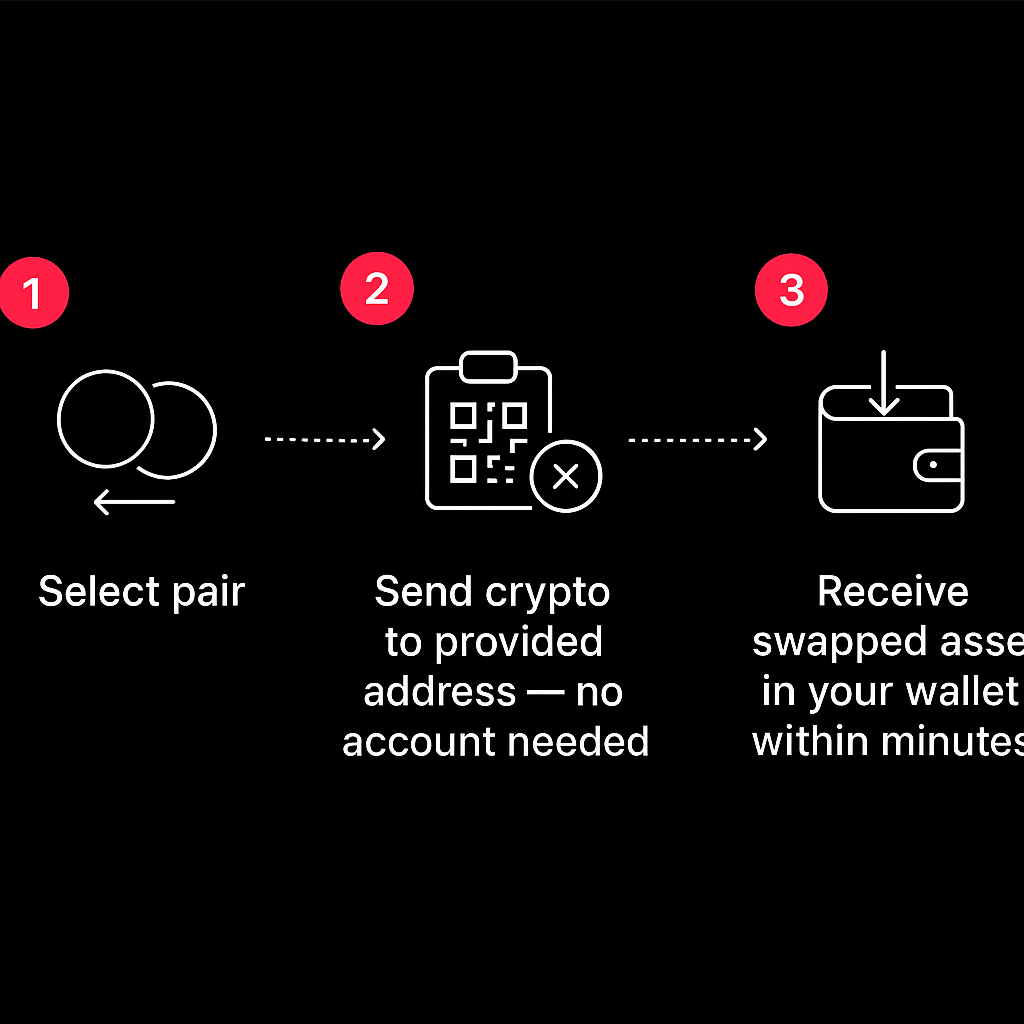
You can swap supported crypto pairs without an account. Choose the pair, send the source asset, and receive the destination asset in your wallet.
An account can add steps you may not need for a crypto-to-crypto swap. You may face email verification, password and 2FA setup, identity-document uploads, approval waits, and a withdrawal step before a transaction that can settle between wallets.
SwapCherry’s process takes three steps. Select the assets, send the source crypto, and receive the destination asset at your wallet address. This guide covers registration-free access, its privacy limits, how to use the service, and the taxes and safety checks that remain your responsibility.
In this article
- Registration is usually the unnecessary part of a crypto-to-crypto swap
- Skipping an account removes work you may never need again
- No KYC is useful here because it limits data collection; calling it anonymity is sloppy
- SwapCherry turns the process into three steps
- If a service holds your funds while you wait for withdrawal, you’ve added custody to a transaction that didn’t require it
- Verify both addresses before sending
- No KYC leaves your tax obligations in place
- Legality depends on your jurisdiction and transaction
- Registration-free swapping fits straightforward conversions
- Start with the pair and skip the paperwork
Registration is usually the unnecessary part of a crypto-to-crypto swap
An account-based exchange usually starts by asking you to create credentials. You may then verify your email, complete identity checks, and wait for approval before trading or withdrawing. It may also apply jurisdiction restrictions or withdrawal limits. An account can make sense for recurring trades, advanced order types, and portfolio tools. It feels excessive for a single conversion.
The basic transaction takes less work. Choose a source and destination asset, provide a receiving wallet, send the source crypto, and receive the result. Registration isn’t technically required for that basic exchange.
Some centralized platforms advertise no-KYC tiers, then impose withdrawal limits or request verification later. That arrangement can change as the provider changes its rules.
The registration-free crypto exchange from SwapCherry states a 0.5% platform fee. It requires no registration or KYC, supports more than 1,500 cryptocurrencies, and uses a non-custodial flow. For a one-off conversion, the simpler route is usually the better one.
Skipping an account removes work you may never need again
“Privacy” gets most of the attention in no-KYC discussions. The everyday benefit is more ordinary: you avoid building an account for a transaction you may perform once.
| Account-based workflow | Registration-free workflow |
|---|---|
| Verify an email address | Enter the swap details |
| Create and secure a password | Provide a destination wallet |
| Configure 2FA and recovery methods | Send the requested asset |
| Submit identity information when required | Receive the destination asset |
| Wait for approval or account limits | Keep no exchange login to recover later |
SwapCherry’s stated no-KYC flow avoids requesting the usual onboarding information, including your name, residential address, phone number, passport details, or selfie. That’s data minimization in a concrete sense: fewer personal documents reach the service because fewer documents are requested.
It also suits a single payment, a DeFi transaction, gaming, savings, or moving between assets. The SwapCherry guide to seven real crypto use cases puts the underlying job neatly: “A swap is the enabling step between holding an asset and giving it a job.”
The same article cites NCA figures saying 67 million Americans hold crypto and 41% use it for investment, payments, or technology. The point is practical. Crypto holders increasingly use assets for different jobs, so moving between assets shouldn’t require a permanent account every time.
No KYC is useful here because it limits data collection; calling it anonymity is sloppy
A no-KYC crypto swap reduces the identity information you provide to the service. The blockchain still records the transaction.
Depending on the network and transaction design, the record may show:
- Wallet addresses
- Amounts transferred
- Timestamps
- Network and platform fees
- Smart-contract calls
- Transaction hashes
Wallet addresses are pseudonymous. They identify addresses rather than displaying your name directly, while blockchain analysis can sometimes cluster related activity or connect an address to an identity through outside information.
Privacy from corporate data collection is a legitimate interest. Tax concealment is a separate matter, and a transparent on-chain swap leaves a public transaction trail. Use registration-free access to limit unnecessary data collection. Treating it as a tool for evasion, concealment, or deceptive conduct is bad advice.
The distinction shows up in a simple example. Suppose you swap BTC bought for $600 three months ago for $1,000 worth of another cryptocurrency through SwapCherry. The source wallet, destination wallet, amount, time, fees, and transaction hashes still exist on-chain. The registration form doesn’t change any of that.
SwapCherry turns the process into three steps
You can follow the full process in SwapCherry’s no-KYC swap guide. The working flow is short, but the details matter.
1. Choose the pair
Choose the asset you’re sending and the asset you want to receive. Confirm the network shown for each asset.
Copy the receiving address from the destination wallet and verify that wallet supports the selected network. In the running example, the reader chooses BTC as the source and another cryptocurrency as the destination, then enters their own wallet address for receipt.
2. Send the source crypto
The service provides a deposit address for the selected source asset. Send the requested cryptocurrency and amount from your wallet to that address. You don’t create an account or wait for identity approval.
Review the quoted exchange rate and final amount before confirming. The displayed total includes the stated 0.5% platform fee. Network costs are separate. They depend on the chains involved. A $1,000 swap at 0.5% carries a $5 platform fee before network costs.
3. Receive the destination asset
After the source transaction receives the required network confirmations, the exchanged asset is sent to the destination address you provided.
SwapCherry says most swaps finish in under two minutes, though network confirmations can take longer. Your order’s displayed timing is the useful estimate.
The service states that it supports more than 1,500 cryptocurrencies. Its homepage also claims more than 2 million swaps processed. It reports 99.9% uptime and a 4.8/5 user rating. These are the service’s own figures, not guarantees for an individual order.
## If a service holds your funds while you wait for withdrawal, you’ve added custody to a transaction that didn’t require it
An account-based exchange commonly credits the result to an internal balance, after which you withdraw it. That creates an extra custody stage between the trade and your wallet.
The service describes its flow as non-custodial:
Your source wallet
        ↓
SwapCherry swap process
        ↓
Your destination wallet
You provide the destination address, and the exchanged asset is sent to that address rather than held in an account balance.
In the running example, the reader sends BTC from their wallet and specifies their own destination wallet. The resulting cryptocurrency is sent to that wallet address, with no exchange balance to withdraw later.
Non-custodial describes who holds the funds during the stated flow. Network confirmations, price movement during execution, and address mistakes remain part of the transaction.
Verify both addresses before sending
Use this checklist for every registration-free swap. These are universal crypto precautions.
Before sending
- Confirm the asset pair. Check that the source and destination assets match your intention.
- Match the exact network. The asset, deposit address, sending wallet, and receiving wallet must all use the exact network shown by the order.
- Verify both full addresses. Compare the complete deposit address and destination address immediately before broadcasting.
- Review the quote. Check the exchange rate. Then check the expected amount. Confirm the 0.5% platform fee, separate network costs, and estimated timing.
- Send the requested asset and amount. Don’t substitute a similar-looking token or alter the amount unless the order permits it.
After sending
- Save the source transaction hash. Record it with the UTC time.
- Keep the order details. Save the order ID, quote, amount, and fees.
- Verify receipt. Confirm that the destination wallet received the expected asset on the intended network.
- Save the destination transaction hash. You may need both records for tax or support purposes.
- Stop for suspicious requests. Never provide a seed phrase or private key. Don’t send an unexpected extra payment or an unrelated identity document.
A registration-free flow removes onboarding. It doesn’t remove the need to read the order carefully.
No KYC leaves your tax obligations in place
The worst advice in this category is “no KYC means no records.”
SwapCherry’s tax guidance puts the point well: “The most overrated crypto advice is ‘no KYC means no records.’ Your tax records still follow the wallet and the transaction.”
Under the US federal tax framework, cryptocurrency counts as property. Exchanging one cryptocurrency for another generally disposes of the first asset. That applies whether you use a custodial exchange, a decentralized application, or a registration-free service.
For the running example:
Fair-market value at swap:   $1,000
Original BTC cost basis:       $600
                              ------
Recognized gain:               $400
The BTC was held for three months, making the $400 generally a short-term gain under the US framing. Ordinary-income rates generally apply to short-term gains. Your complete tax situation controls the result. Crypto swaps generally don’t qualify for Section 1031 like-kind deferral under post-2017 rules.
A transfer between wallets you own generally isn’t a disposal by itself. The exchange of BTC for another asset is the event that requires tax attention.
A non-custodial service may not issue an automatic 1099-DA. You still must file. The digital-asset question on Form 1040 remains relevant, and the absence of a tax form doesn’t change the transaction.
Keep a ledger for every swap:
| Record | What to save |
|---|---|
| Timing | UTC date and time |
| Asset sold | Asset, amount, cost basis, acquisition date |
| Asset received | Asset, amount, and fair-market value at execution |
| Costs | Platform fee and network fee |
| Wallet trail | Deposit address, destination address, both transaction hashes |
| Order trail | Order ID, quote, and final amount |
Rev. Proc. 2024-28 calls for wallet-specific basis records; keep the wallet and transaction trail for each disposal.
Congress repealed the DeFi broker rule on April 10, 2025. The repeal concerns broker reporting, while taxable swaps remain reportable. Underpayment can trigger accuracy-related penalties of up to 20%. Civil-fraud penalties can reach 75%. Deliberate evasion can carry criminal consequences.
Outside the US, tax treatment varies. Keep the same records and consult a qualified professional when your activity or records become complicated.
Legality depends on your jurisdiction and transaction
SwapCherry’s FAQ gives a narrow US answer: for a US individual, using a service that doesn’t request identity verification is generally not illegal by itself. Sanctions, fraud, state law, restricted assets, and the facts of the transaction can change that answer.
Keep three issues separate:
- Your use of the service. Check the rules in your jurisdiction before using any service, especially for sanctions, restricted assets, and reporting.
- The operator’s duties. Rules governing a service that facilitates swaps are separate from the rules governing a customer’s transaction.
- Your tax responsibility. The service’s account and reporting practices don’t determine whether you must report a disposal.
Local law is the hardest part to generalize. This article can explain the transaction, but it can’t determine whether your jurisdiction permits your specific asset, amount, or use.
“Legal” also has a narrow meaning. It doesn’t establish that a transaction is safe, tax-free, or suitable for every user.
Registration-free swapping fits straightforward conversions
A registration-free route is a good fit when:
- You need a one-off crypto-to-crypto conversion.
- You don’t want to create an account for a single transaction.
- You prefer to limit the personal data supplied during onboarding.
- You want the received asset sent to a wallet you control.
- Your source and destination assets and networks are supported by the service.
Choose a different workflow when you need recurring trading, advanced order types, or account-based portfolio tools. Those features justify a continuing account for some users.
Registration-free access still requires the basics. Understand the network and verify both addresses. Review the complete quote, keep tax records, and check local restrictions. The service’s stated 0.5% platform fee is separate from network costs, and network confirmations determine how long settlement takes.
Start with the pair and skip the paperwork
Open SwapCherry and select the source and destination assets. Copy the receiving address from your wallet. Then review the quote and fee. Send the requested asset to the provided deposit address, then verify receipt.
Before you close the order, save the quote, UTC time, fees, addresses, and both transaction hashes. Registration-free removes paperwork. The transaction—and your responsibility for it—remain visible.