How to swap DOGE to BTC without KYC
coverImage: "/images/doge-btc/img-1.png"
How to swap DOGE to BTC without KYC
Generic “best no-KYC exchange” lists are the wrong way to choose this swap. So focus on DOGE/BTC liquidity, the final BTC payout and the delivery network instead of a coin-count trophy.
SwapCherry gives you the direct workflow: no registration or KYC, non-custodial delivery, a stated 0.5% fee, and the quote shown before you confirm. A typical estimate is 5–20 minutes, though confirmations and congestion can change it; Monivo’s DOGE-to-BTC guide gives that range for this pair.
You’ll prepare the wallets and run the DOGE-to-BTC swap on SwapCherry. And choose a fixed or floating quote. Compare the BTC payout and handle the legal and tax records. The final checklist is for the moment before you broadcast DOGE.
In this article
- What you need before starting
- How to swap DOGE to BTC on SwapCherry
- Choose between a fixed and floating rate
- The 0.5% fee is only part of the cost
- No-KYC is legal for ordinary users, not a license to hide crime
- No 1099 does not mean no tax
- Save these five records before you move on
- Confirm these points before sending DOGE
What you need before starting
Prepare these items before opening the swap form:
Swap DOGE to BTC on SwapCherry — /swap/doge-to-btc
- DOGE in a wallet you control. Leave enough balance for the amount you want to swap and any Dogecoin network fee.
- A Bitcoin receiving wallet. It must accept native BTC on the Bitcoin network.
- The receiving address ready to copy. Keep the wallet open so you don’t type the address manually.
- Your DOGE acquisition records. Locate the acquisition date, amount, and cost basis before trading.
If you’re converting 1,000 DOGE, your DOGE wallet should contain the intended amount plus any sending fee. So keep your Bitcoin wallet open and ready to provide its BTC address. The live quote determines the BTC amount.
Check the receiving wallet’s asset and network. A BTC address on the wrong network can leave funds inaccessible or require recovery support. Select native Bitcoin wherever the wallet offers multiple networks.
Before sending, locate your DOGE acquisition date and cost basis. After completion, you’ll add the BTC value and fees. Also record the transaction hashes and addresses. Crypto-to-crypto exchanges are generally taxable disposals. This preparation saves you from reconstructing the transaction later.
How to swap DOGE to BTC on SwapCherry
The form takes a few steps; the irreversible decision is the BTC address.
-
Open SwapCherry and choose the pair.
Select DOGE as the asset to send and BTC as the asset to receive. The direction matters: DOGE leaves your wallet, and BTC comes back. -
Enter the amount.
For the worked example, enter 1,000 DOGE. SwapCherry will display the current quote and estimated BTC payout. -
Review the quote.
Check the BTC amount, exchange rate, stated fee, and any minimum. Minimums depend on available liquidity and appear before confirmation. -
Choose the rate type if offered.
A fixed rate locks the quote for approximately 10 minutes. A floating rate settles at the market rate when the DOGE deposit confirms. -
Paste your BTC receiving address.
Copy it directly from your Bitcoin wallet. Manual typing creates an avoidable failure point. -
Verify the address and network.
Compare the first and last six characters with the address in your wallet. Confirm that it’s the intended native Bitcoin destination. SwapCherry’s guidance is simple: “Always verify the address and network before sending.” -
Confirm the final terms.
Check the payout, rate type, fee, and minimum. If the quote changed, stop and review the new amount. -
Send DOGE to the deposit address.
SwapCherry provides the DOGE address for the transaction. Send the intended amount from your wallet and save the transaction hash. -
Wait for delivery.
DOGE confirmations come first. BTC delivery follows, and congestion can extend the estimate.
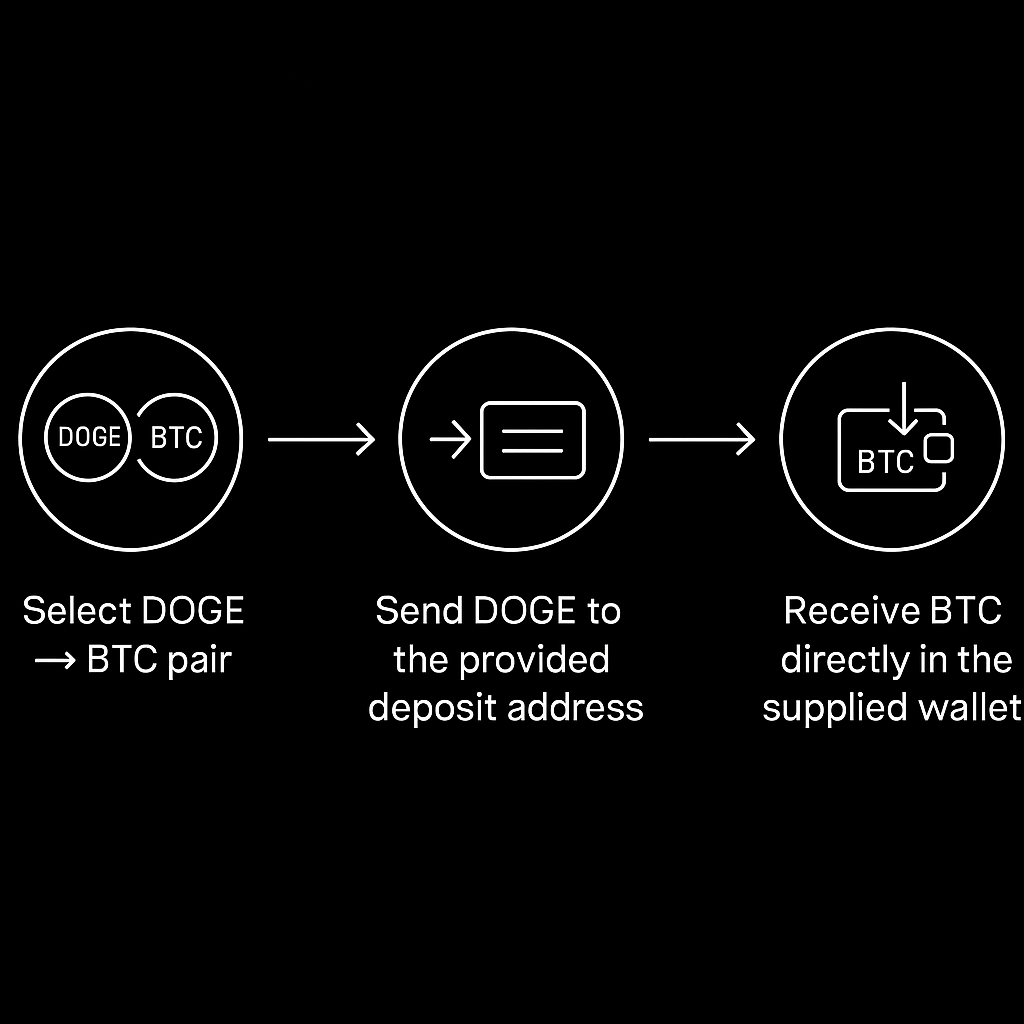
SwapCherry keeps this pleasantly short: Choose the pair. Send DOGE. Receive BTC directly in your wallet. Because the flow is non-custodial, SwapCherry sends the exchanged BTC to the wallet address you supplied rather than holding it in an exchange account.
Choose between a fixed and floating rate
The rate choice determines how much market movement you accept while the DOGE transaction confirms.
| Rate type | What happens | Choose it when |
|---|---|---|
| Fixed | The quoted rate is locked for roughly 10 minutes. | You want a defined BTC payout and can send promptly. |
| Floating | The rate settles at the market rate when the DOGE deposit confirms. | You accept a changing BTC payout during processing. |
With a 1,000-DOGE input, a fixed quote lets you decide using the BTC payout displayed at that moment. If the transaction isn’t sent or confirmed within the quote window, the rate can expire and require recalculation.
A floating quote can change between starting the swap and confirmation. The result may be higher or lower. Don’t treat the initial estimate as a guaranteed BTC amount.
Choose fixed when the displayed payout works and you’re ready to send immediately. Choose floating only when you knowingly accept price movement.
The 0.5% fee is only part of the cost
SwapCherry’s fee for this article is 0.5%; its homepage separately says the exchange rate and final amount appear before confirmation.
If the 0.5% fee were calculated directly on a 1,000-DOGE input, it would equal 5 DOGE. Don’t assume that’s how the final quote deducts it; use the displayed BTC payout and fee breakdown.
Your swap cost has several components:
- SwapCherry’s stated fee. The applicable fee is shown as part of the quoted exchange terms.
- The provider spread. This is the difference between the broader market conversion rate and the rate offered for the swap.
- The DOGE network fee. This is paid from the sending side or wallet balance, depending on the transaction flow.
The quote shows the provider’s exchange terms; check separately how the DOGE network fee is charged in the transaction preview. Compare the BTC payout for the same DOGE input under the same rate type.
For the 1,000-DOGE example, record SwapCherry’s displayed BTC payout before confirming. I can’t verify the live DOGE/BTC spread from this page, so the quote shown to you at confirmation beats any fee comparison written here.
A platform advertising 1,500 coins tells you almost nothing about the DOGE/BTC quote. A large asset catalogue doesn’t answer the questions that decide this transaction. Is DOGE/BTC available? What BTC amount is quoted? Where does the BTC arrive?
| Service or recommendation | Reported detail | Use this comparison |
|---|---|---|
| SwapCherry | 0.5% stated fee; no KYC or registration; non-custodial flow; 1,500+ cryptocurrencies | Compare the BTC payout for the same DOGE input under the same rate type. |
| Monivo’s recommendations | FixedFloat, ChangeHero, and ChangeNOW | Treat the list as a competitor guide’s recommendation, then compare the live BTC payout yourself. |
| LeoDex | DOGE-to-BTC access through THORChain or Chainflip | Compare the final BTC payout, network, custody model, and transaction requirements. |
Feature counts are background information. DOGE/BTC availability and native BTC delivery matter most. Quote expiry and the amount reaching your wallet matter too.
No-KYC is legal for ordinary users, not a license to hide crime
The legal summary here is a map, not legal advice. Rules vary by jurisdiction, custody model, transaction purpose, and regulatory classification.
No KYC means SwapCherry doesn’t require registration or identity checks for this flow; it does not make the transaction anonymous or untraceable. The relevant rules depend on custody, intermediation, jurisdiction, and purpose. Personal self-custody is only one part of that analysis.
A self-custody user swapping personal assets faces a different analysis from a business custodying customer funds, transmitting value for others, or processing sanctioned funds.
United States
US FinCEN guidance distinguishes a person using an unhosted wallet to buy or sell cryptocurrency for their own account from a money transmitter. Personal use does not itself create a money-transmitter registration or KYC obligation.
The 2024 DeFi broker rule was voided by Congress through H.J.Res.25, signed on April 10, 2025. Treasury removed the rule effective July 10, 2025. Centralized exchanges remain a separate regulatory and reporting category.
European Union
MiCA regulates crypto-asset service providers. Self-custody and fully decentralized activity may sit outside that perimeter when no regulated provider is involved. The EU Travel Rule applies to transfers handled by crypto-asset service providers; it doesn’t apply to person-to-person transfers between self-hosted wallets without one.
That boundary doesn’t erase sanctions, anti-money-laundering, or tax obligations. The applicable result depends on the precise facts.
United Kingdom
There is no UK offense consisting simply of trading crypto without KYC. Crypto firms face FCA requirements and financial-promotion rules, while users remain responsible for tax reporting. HMRC generally treats a crypto-to-crypto exchange as a disposal at its market value in pounds.
No-KYC is lawful for ordinary use in these frameworks; it isn’t permission for sanctions evasion, money laundering, or deliberate tax evasion. The boring compliance boundary still applies.
If you later send the BTC to a regulated exchange or bank, you may face source-of-funds questions. Keep the quote, wallet addresses, and transaction hashes so the swap has an explainable history.
No 1099 does not mean no tax
For US taxpayers, the IRS treats cryptocurrency as property. Exchanging DOGE for BTC generally disposes of the DOGE.
For a US taxpayer, the basic calculation uses the BTC’s fair-market value at the exchange minus the DOGE cost basis. Transaction fees may affect basis or proceeds under the applicable rules. This treatment is jurisdiction-specific, so don’t apply the formula automatically to another country.
Crypto also doesn’t receive a general like-kind exchange deferral under current Section 1031 treatment.
The swap remains reportable even when:
- No centralized exchange is involved.
- You provide no identity document.
- You receive no tax form.
- The BTC stays in your own wallet.
Moving crypto between wallets you own is a different event and is generally not taxable by itself.
Under the framework described by LeoDex, non-custodial swaps don’t receive automatic 1099-DA reporting. LeoDex summarizes the distinction this way: “No 1099 means no automatic reporting — it has never meant no tax.”
Centralized exchanges are a separate category: the notes describe gross-proceeds reporting for 2025 trades and cost-basis reporting for 2026 and later trades. Don’t treat the absence of a form from a non-custodial swap as evidence that no disposal occurred.
Holding period also matters in the US. Assets held for more than one year may receive long-term capital-gains treatment at applicable 0%, 15%, or 20% rates. Shorter holdings generally produce short-term gains taxed at ordinary income rates, subject to your situation.
The UK, Canada, Australia, Germany, and many EU jurisdictions generally treat crypto-to-crypto exchanges as disposals, with important local differences. Check your local rules or ask a qualified tax professional. I can explain the transaction mechanics; I can’t determine your filing position from a paragraph on a website.
Blockchain activity remains public. Later exchange records, wallet clustering, and source-of-funds checks can connect transactions to you.
Save these five records before you move on
Create the entry as soon as the swap completes, while the quote and transaction data are still available:
- Date and time in UTC.
- DOGE sold, its cost basis, and acquisition date.
- BTC received and its fair-market value in your home currency at execution.
- Network, protocol, and other fees.
- The quote or confirmation, transaction hashes, and sending and receiving addresses.
For US readers, Rev. Proc. 2024-28 makes wallet-level basis allocation relevant; keep records separated by wallet rather than treating every address as one undifferentiated pool.
Keep the DOGE wallet record connected to the later BTC wallet record, especially if you eventually send the BTC to a KYC exchange. Tools such as Koinly, CoinTracker and CoinLedger can ingest wallet data and help organize transactions. They’re software tools for organizing records.
The boring part is keeping records; skipping it is how a five-minute swap becomes a tax reconstruction project.
Confirm these points before sending DOGE
Before broadcasting the transaction, verify:
- DOGE is the sending asset and BTC is the receiving asset.
- The BTC address came from the intended wallet.
- The first and last six characters match.
- The Bitcoin network is correct.
- The displayed BTC payout and SwapCherry’s 0.5% fee are acceptable.
- You understand whether the quote is fixed or floating.
- Your amount meets the displayed minimum.
- You’ve saved the quote and know where you’ll record the transaction hash.
If the pair, network, address, payout, or rate type is unclear, don’t broadcast DOGE.