How to choose the right USDT network
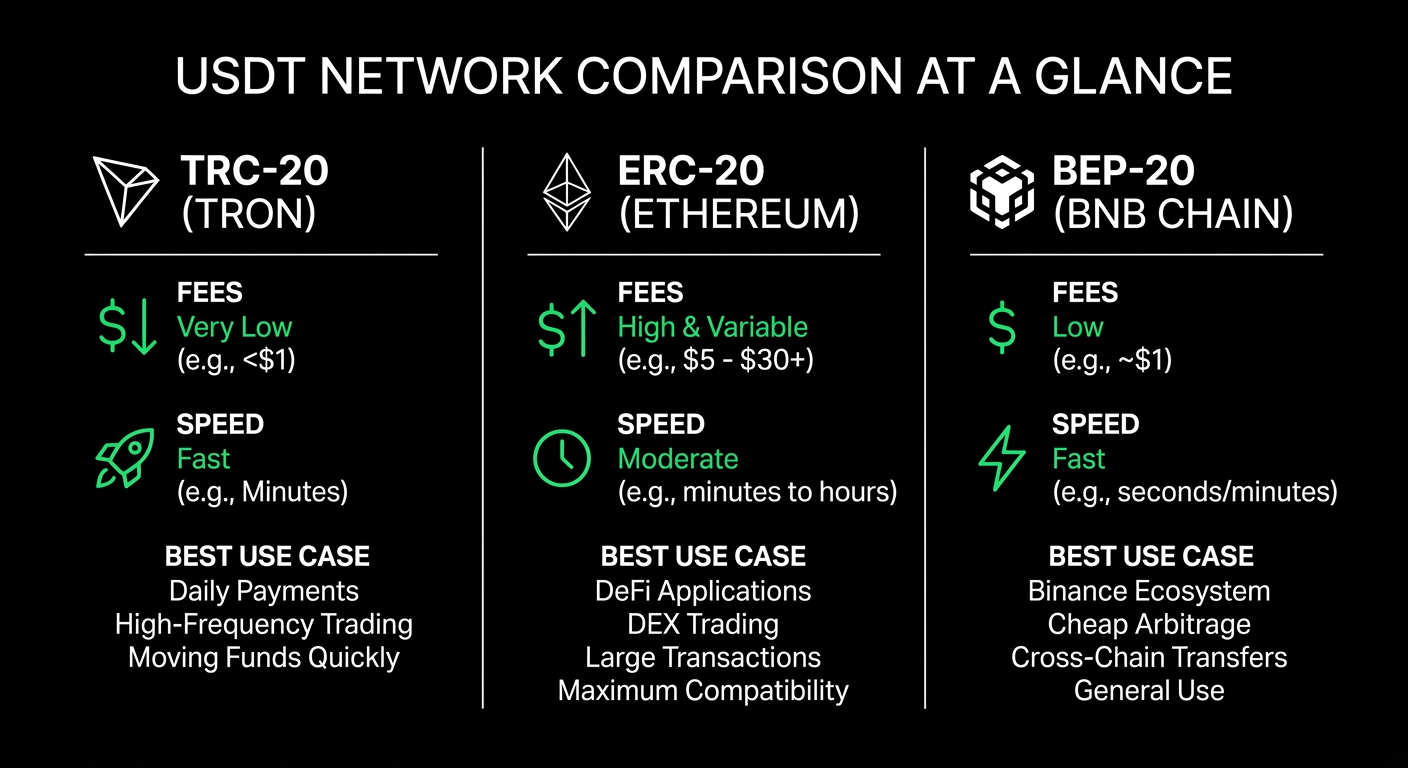
Use the recipient’s supported network first, then compare fees and speed. So choose TRC-20 for supported Tron destinations when low cost matters. Choose BEP-20 for BNB Chain and ERC-20 for Ethereum. A 0x address alone cannot tell you which one to use.
The “cheapest USDT network” question is badly framed. The cheapest route is useless if the exchange, casino, wallet, or application won’t credit it. But a transfer can succeed on-chain while the recipient’s platform leaves it uncredited.
This guide starts with the decision rule. It compares TRC-20, ERC-20, and BEP-20, then covers the 0x address trap, safe sending, network swaps, and wrong-network recovery.
In this article
- USDT has separate balances on each network
- The recipient’s network decides every transfer
- TRC-20 is usually the practical low-cost choice
- ERC-20 is expensive, but Ethereum compatibility is sometimes the whole point
- BEP-20 is efficient when the recipient supports BNB Chain
- Fees and speed are useful only after compatibility
- Choose by destination, then optimize the route
- The
0xaddress is a warning, not a network selection - Use an exchange for most cross-network swaps
- If you used the wrong network, stop immediately
- Recipient support first; fees second
USDT has separate balances on each network
The USDT in an Ethereum deposit address is tracked by Ethereum. USDT in a Tron address is tracked by Tron. And while the dollar value is intended to stay equivalent, each network maintains its own contracts and balances.
Eco.com describes each chain as having its own USDT contract and balance sheet at Tether. That is the detail many fee comparisons skip.
An exchange can list USDT deposits on selected networks. An online casino might accept TRC-20 only. An Ethereum DeFi application might require ERC-20. The token’s dollar value doesn’t make those deposits interchangeable.
A wallet that displays USDT on several chains creates another source of confusion. Seeing a balance in a wallet proves that the wallet can read that chain; it does not prove that an exchange or application will credit the same token there.
This guide focuses on TRC-20, ERC-20, and BEP-20.
The recipient’s network decides every transfer
Open the destination’s deposit instructions before comparing prices. The network you use to withdraw must match the network selected on the recipient’s deposit page.
What network does the destination list?
- TRC-20 listed: send USDT over Tron.
- ERC-20 listed: send USDT over Ethereum.
- BEP-20 or BSC listed: send USDT over BNB Chain.
- Several networks listed: choose the least expensive compatible route after checking the sending platform’s charge.
- Only an address provided: stop and ask which network to use.
If the recipient is an exchange, casino, or payment platform, its deposit page controls the decision. A casino that accepts TRC-20 only will not become BEP-20-compatible because BEP-20 costs less.
Maya is withdrawing USDT to a casino that accepts TRC-20 only. Her exchange offers all three networks, and BEP-20 appears cheaper. She selects TRC-20. Compatibility settles the first question; price comes afterward.
If the destination cannot confirm its supported network, wait. A clear network label is worth more than a low withdrawal fee.
TRC-20 is usually the practical low-cost choice
TRC-20 USDT runs on Tron. Personal-wallet transaction costs are typically under $1, and some wallets can reduce the amount of TRX needed by using available network resources.
Tron’s block time is about three seconds. Published confirmation estimates range from near-instant to one to three minutes, depending on the wallet, exchange, and crediting policy. Fast blocks do not guarantee fast exchange deposits.
A TRC-20 address begins with T. That prefix identifies the address format, but it still doesn’t prove that the receiving service accepts or credits TRC-20 USDT.
Choose TRC-20 for an exchange deposit, remittance, or casino that explicitly lists Tron. If the destination is an Ethereum-only application, Tron is the wrong route regardless of its fee.
ERC-20 is expensive, but Ethereum compatibility is sometimes the whole point
ERC-20 means USDT on the Ethereum network. It remains the route for Ethereum-only wallets and smart contracts. DeFi applications and many NFT services use it too. Ethereum has broader documented DeFi and NFT support; use ERC-20 when the destination requires that network.
Published planning figures put ordinary personal-wallet fees around $3–$15+, with peaks near $30 during congestion. These are indicative ranges rather than live quotes.
Confirmation estimates vary across providers: published figures range from one to three minutes typically to five to 15 minutes in some exchange matrices, depending on congestion and exchange processing.
You’ll also need ETH in a personal wallet to pay gas. Without ETH for gas, a wallet holding ERC-20 USDT may be unable to send it.
Use ERC-20 when the destination explicitly requires Ethereum network compatibility. The fee is the price of access to that ecosystem.
BEP-20 is efficient when the recipient supports BNB Chain
BEP-20 USDT runs on BNB Chain, formerly called Binance Smart Chain. It can be a low-cost EVM route where the recipient explicitly supports BNB Chain.
Personal-wallet fees are commonly below $0.50, with planning ranges around $0.01–$0.50. Confirmation usually takes seconds, although an exchange may quote an operational estimate of about 30 seconds.
Eco.com reports these Binance withdrawal examples from May 2026:
- USDT-BEP-20: 0.29 USDT
- USDT-TRC-20: 1 USDT
- USDT-ERC-20: 1.6 USDT
Those figures are a dated example, not a permanent Binance price list. A Binance fee is not a forecast for MEXC, OKX, or your wallet. Exchange charges change frequently.
Choose BEP-20 when the recipient lists BEP-20 or BNB Chain and the route is cheaper for your transfer.
Fees and speed are useful only after compatibility
This is where most comparison charts quietly mislead you. They put personal-wallet gas costs and exchange withdrawal charges in the same column.
A personal-wallet fee is the amount paid to the blockchain. Ethereum requires ETH for gas. BNB Chain requires BNB. Tron may require TRX or sufficient network resources.
An exchange withdrawal fee is the charge shown by the exchange when it sends your funds. It may be higher or lower than the underlying network cost.
| Network | Typical personal-wallet fee | Typical confirmation | Address clue | Best fit |
|---|---|---|---|---|
| TRC-20 | Indicatively under $1 | Near-instant to 1–3 minutes | T... |
A destination that lists TRC-20 |
| ERC-20 | Indicatively $3–$15+, with higher peaks | Published estimates: 1–3 minutes typical; 5–15 minutes in some exchange matrices | 0x... |
Ethereum network applications |
| BEP-20 | Indicatively $0.01–$0.50 | Seconds to about 30 seconds | 0x... |
A destination that lists BNB Chain |
These ranges are planning figures from published guides rather than results from a controlled benchmark. I can’t tell you what your exchange will charge today; measure that on its withdrawal screen before choosing. The same applies to confirmation time.
Exchange charges also vary across providers and over time. Treat any comparison table as orientation, then check the transaction you’re about to make.
Choose by destination, then optimize the route
Start with what will receive the funds.
Exchange, casino, or payment platform: follow the exact network listed on its deposit page. If it supports several, compare the routes. Choose the lowest current total cost.
Ethereum DeFi or NFTs: use ERC-20 unless the application explicitly supports another network. A Tron or BNB Chain transfer stays on that chain.
Compatible personal wallets: if both support several networks, choose the lowest current total cost after confirming that the receiving application credits that network. You may also need the native gas token in the sending wallet.
Unfamiliar destination: test the route before sending the full amount. The complete address-and-network procedure appears below.
For Maya, the casino’s TRC-20-only instruction settles the choice. She doesn’t need a beauty contest between three chains.
The 0x address is a warning, not a network selection
A T... prefix indicates a Tron-format address. A 0x... prefix can indicate Ethereum, BNB Chain, or Polygon. The prefix tells you the address format; it does not identify the network selected by the recipient.
BEP-20 and ERC-20 create the most dangerous mistake because their addresses look identical. You can send BEP-20 USDT to an address displayed for ERC-20, and the transaction may process successfully. If the receiving exchange doesn’t support BEP-20 for that deposit, the funds may remain inaccessible or uncredited.
A multi-network wallet can make this look safe. It may display both Ethereum and BNB Chain assets after you configure them, while the exchange or casino recognizes deposits on only one chain.
Before pressing Send:
- Open the receiving platform’s USDT deposit page.
- Select the exact network.
- Copy the address shown for that selection.
- Recheck the network label in the sending app.
- Compare the first and last characters of the pasted address.
- Send a small test transaction, such as 5 USDT, to an unfamiliar destination.
- Wait for the deposit to appear before sending the balance.
For Maya, the casino’s T... address and TRC-20 label agree. If she selected BEP-20 because it was cheaper, the transaction might succeed and still remain uncredited.
Wallets commonly reject ERC-20 transfers aimed at TRC-20-format addresses. TRC-20 sent toward an Ethereum address generally cannot be recovered. Treat the network label as mandatory data.
Use an exchange for most cross-network swaps
A bridge is often extra machinery for a problem an exchange solves more predictably.
For a typical retail transfer:
- Deposit USDT to a reputable centralized exchange on the source network.
- Wait for the deposit to credit.
- Withdraw USDT on the destination network.
- Confirm the exchange’s fee, minimum, and network label before submitting the withdrawal.
To move TRC-20 USDT to ERC-20, select TRC-20 on the exchange deposit page, send the funds, wait for credit, then select ERC-20 on the withdrawal page and paste the Ethereum destination address. The CEX route uses a fixed withdrawal charge, while some bridge routes add swap slippage. It handles the TRC-20-to-Ethereum leg without asking you to operate a bridge. You still take on custody, KYC, account-access, and compliance risk.
That tradeoff matters. You’re exchanging technical complexity for reliance on an intermediary.
Other mechanisms exist:
- Tether’s native chain swap: a canonical burn-and-mint process, generally aimed at institutional transfers around $100,000 or more. Turnaround can take hours to days.
- USDT0: a LayerZero omnichain extension for supported EVM networks. It uses self-custody and may complete in roughly one to five minutes where available, but it does not solve TRC-20 legs.
- Third-party bridges: Stargate and Across support various EVM or Solana routes. Wormhole/Portal and LI.FI do too. Eco.com’s comparison does not list a native TRC-20 route for these services.
Verify any bridge claiming to connect Tron and Ethereum. Check the exact USDT contract, both supported networks, custody model, limits, fees, and final destination. A bridge is a tool for a specific route, not a default upgrade over an exchange.
If you used the wrong network, stop immediately
Don’t send a second transaction to “push” the first one through. It cannot repair the original transfer.
- Find the transaction hash.
- Open it in the explorer for the network actually used.
- Confirm whether it succeeded, failed, or remains pending.
- For a self-custody wallet, check whether the token is hidden and add the correct contract manually.
- For an exchange, casino, or swap service, do not try to edit the account yourself; gather the transaction hash and destination address. Also include the selected network and exchange or swap ID.
- Contact the receiving platform through its official support channel.
Use the explorer for the network used: Tronscan for TRC-20, Etherscan for ERC-20, or BscScan for BEP-20.
If Maya sends BEP-20 to the casino despite its TRC-20 instruction, the transaction may succeed and still remain uncredited. She should save the hash and contact the casino’s official support. A refund is not guaranteed.
Recovery depends on who controls the destination. If the destination is a self-custody wallet whose key holder will not help, recovery is generally outside your control. A custodial platform may be able to investigate, but support recovery is case-by-case and may carry a fee.
If you used ChangeNOW, its published recovery details apply only to a ChangeNOW swap handled within ChangeNOW’s own custody and support workflow. It says an unprocessed swap may be recoverable, while a completed swap requires case-by-case handling. A recoverable refund may require twice the network fee. Funds sent to a wallet ChangeNOW does not control generally cannot be retrieved.
Don’t seek help from recovery accounts on Reddit, Telegram, or X. Never share a seed phrase or private key.
Recipient support first; fees second
Use TRC-20 when the recipient supports Tron and low cost matters.
Use BEP-20 when the recipient supports BNB Chain and its route costs less.
Use ERC-20 when the destination requires Ethereum network compatibility.
The operating rule is:
Recipient network first. Current fee second. Address prefix third. Test transfer always.
Never infer ERC-20 versus BEP-20 from 0x. If the recipient cannot clearly name the network, don’t send yet.