A crypto swap is not the same as an exchange
A crypto swap is not the same as an exchange
Swap BTC to XMR right here — live widget below.


Swap Bitcoin → Monero
Live rate · settles in minutes
“I have one crypto and want another. Where do I go?”
But many beginner guides call every token conversion a “DEX swap.” But that shortcut is exactly what makes the choice confusing. A DEX and an instant swap service can both help you exchange tokens, but they use different mechanics and ask different things of you.
Use a centralized exchange (CEX) for fiat access or frequent trading. Use a DEX to trade on-chain from your own wallet, usually within one network ecosystem. If you already hold crypto and want another asset sent to your wallet without opening an account, use an instant swap service.
You don’t need an order book, candlestick chart or maker/taker fee schedule for every crypto conversion. So this guide compares the three routes by custody, mechanics, fees, speed, privacy and setup, then gives you a practical decision rule.
The quick decision:
- Fiat or active trading: choose a CEX.
- On-chain token access from your wallet: choose a DEX.
- A direct crypto-to-crypto conversion: choose an instant swap service such as SwapCherry.
In this article
- What do you need to do today?
- The three models use different mechanics
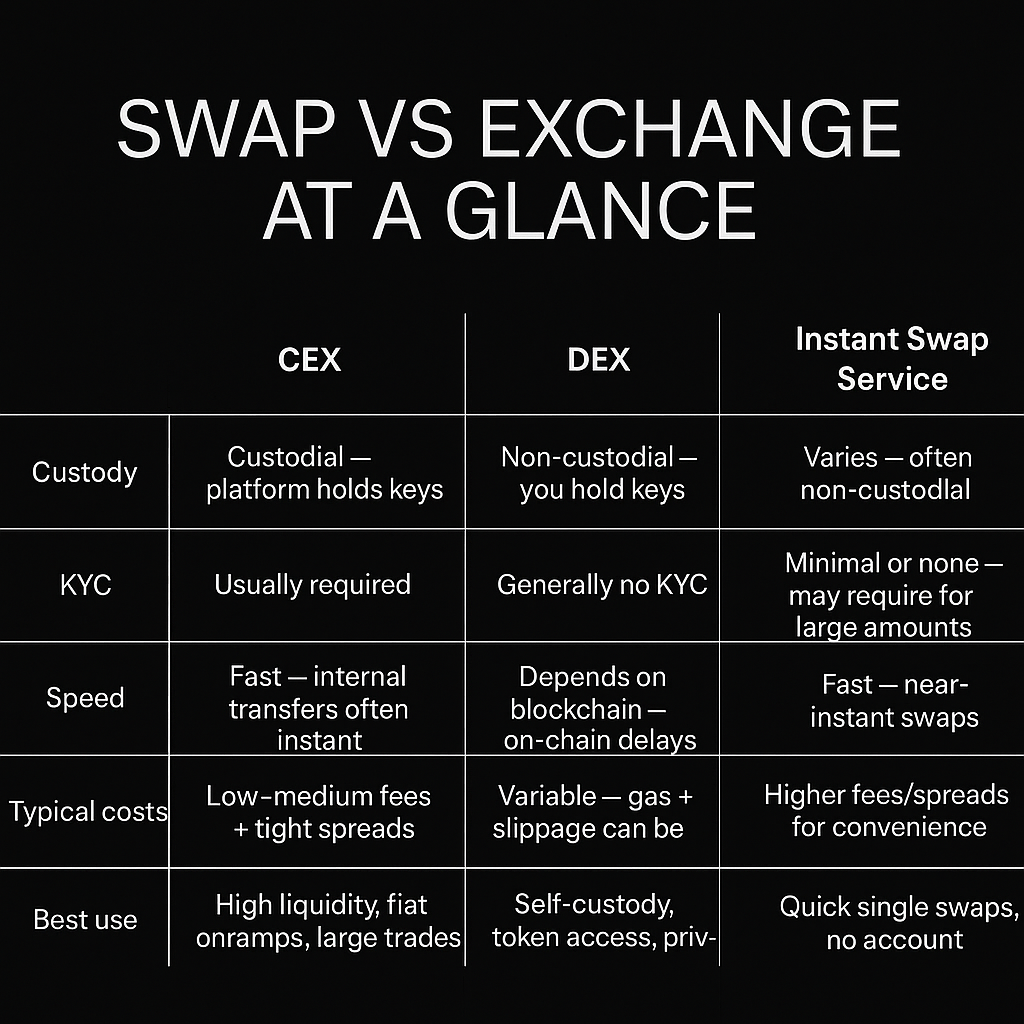
- The three options at a glance
- The lowest headline fee is not always the lowest total cost
- “Instant” depends on where the delay happens
- Privacy starts with the account you don’t have
- “Not your keys, not your crypto” changes the choice
- Choose by task, not by brand
- Why SwapCherry fits a direct crypto conversion
- Four checks before you send crypto
- The short answer
What do you need to do today?
Start with the transaction, not the brand name.
But Maya already holds BTC in her personal wallet and wants USDT on another supported network before making a payment. But she doesn’t want to open an exchange account, wait for a bank transfer, learn an order book or connect her wallet to a DEX.
Her choices are straightforward:
- Buy or sell with fiat, or trade frequently: use a centralized exchange, usually called a CEX.
- Trade tokens directly on one blockchain with your own wallet: use a decentralized exchange, or DEX.
- Move one crypto asset into another without opening an account: use an instant swap service such as SwapCherry.
So the key distinction is who does what. A DEX routes a wallet-signed transaction through on-chain liquidity. SwapCherry accepts the source asset at a provided address. It delivers the destination asset to the wallet address you supply. You don’t connect your wallet to the swap interface, although you do provide the destination address.
So the difference affects custody, network fees, setup and the number of steps involved. The three options are related, but they aren’t interchangeable.
The three models use different mechanics
A CEX records trades in an account ledger. A DEX executes a wallet-authorized transaction through smart contracts. An instant swap service uses a send-and-receive flow.
A CEX keeps an internal account balance
A CEX is a company-operated trading platform. It typically holds deposited funds, runs an order book, matches buyers with sellers, and records trades in its internal database.
And the Webisoft comparison describes the practical consequence: the platform generally controls the private keys for deposited assets. Your account shows a platform-recorded balance, while the platform handles the wallet operations.
This model makes sense when you need to connect a bank account or card, convert fiat to crypto, trade frequently, or access liquidity that can support larger orders. It also brings account creation, identity checks, deposit rules, withdrawal limits, and custodial risk.
To use a CEX, Maya would create an account, complete the exchange’s requirements, fund it, trade BTC for USDT, and withdraw the USDT. It works. It’s simply a long route for a short trip.
A DEX uses your wallet and on-chain liquidity
A DEX is an on-chain marketplace. You connect your own wallet and authorize a transaction through a smart contract.
Many DEXs use automated market makers, or AMMs. An AMM holds token pairs in liquidity pools. The quoted price changes as trades change the pool’s balance. Buying more of one token from the pool makes that token scarcer there, which changes the price available for the next trade.
You retain control of your wallet keys, but you must understand the network, approve transactions, pay gas, check slippage, and verify token addresses. You’ll also need the network’s native asset to pay transaction fees.
A DEX may suit a token available on-chain but absent from the CEXs you use. A DEX usually operates within a network ecosystem; moving between networks may require a bridge or a separate cross-chain route, each adding another transaction and another failure point.
An instant swap service handles the route for you
An instant swap service accepts one asset and sends another to the wallet address you provide. It doesn’t require an order book or a connected wallet.
With SwapCherry, the basic flow is:
- Choose the source and destination assets.
- Enter the amount.
- Send the source crypto to the provided address.
- Receive the destination asset at the wallet address you provide.
SwapCherry supports cross-chain pairs, so you can request an exchange involving assets on different networks without navigating a DEX interface. The service flow remains simple: send the source asset, then receive the destination asset in your wallet.
The three options at a glance
| Model | Custody | KYC and account | Speed | Typical costs | Best for |
|---|---|---|---|---|---|
| CEX | Platform custody for deposited funds | Account required; KYC often required, especially for fiat services | Internal trade is fast; ACH funding may take 3–5 business days | Trading fee, spread, deposit, and withdrawal costs | Fiat access and active trading |
| DEX | You keep wallet custody | Usually no account; wallet interaction required | Wallet transaction waits on network confirmation and available liquidity | Network fee and pool pricing; price impact may add cost | Same-chain, on-chain token trading |
| Instant swap service | Non-custodial swap flow | No registration or KYC with SwapCherry | SwapCherry service processing is measured in minutes; confirmation varies by network | SwapCherry’s flat fee is 0.5% | Direct crypto-to-crypto conversion |
For a simple conversion, compare the final amount you’ll receive. Then check the custody model and required setup. The cheapest-looking line item may not describe the entire route.
The lowest headline fee is not always the lowest total cost
A CEX can advertise a 0.1% trading fee. That number only describes the trade after your funds are already on the exchange.
Paybis compares base-tier trading fees of 0.1% on Binance with 0.25%–0.40% on Kraken Pro. It also lists about 3.99% plus an embedded spread for Coinbase debit-card purchases. Paybis card pricing includes a 1.49% service fee, a 4.5%–8.5% processing fee for card transactions over $50, and a network fee. These are Paybis’s published comparison figures, not universal market rates.
The card figures describe buying crypto with fiat. They aren’t directly comparable with swapping crypto you already own.
| Model | Typical fee | What it may exclude |
|---|---|---|
| CEX trading fee after funding | 0.1% on Binance base tier to 0.25%–0.40% on Kraken Pro | Deposit, withdrawal, spread, and fiat-funding costs |
| Coinbase debit-card purchase | About 3.99% plus embedded spread | Spread isn’t itemized separately |
| Paybis card purchase | 1.49% service fee plus 4.5%–8.5% processing fee and network fee | Gateway-specific costs |
| SwapCherry | 0.5% flat | Network conditions may affect blockchain settlement |
For arithmetic, a $1,000 funded CEX trade at 0.1% costs $1 for the trade alone. SwapCherry’s 0.5% fee on $1,000 is $5 before applicable network costs. The CEX figure says nothing about the cost of funding and withdrawing; SwapCherry’s $5 is the stated service fee for the conversion, before applicable network costs. Neither figure covers the full route cost.
The published fee structures are comparable here, but no static comparison can tell you which route produces the most USDT for every pair and network without the live quote, spread and network conditions. Check the final receive amount before sending.
“Instant” depends on where the delay happens
There are two clocks in a crypto transaction: the service’s processing time and the blockchain’s confirmation time.
Paybis’s published comparison says Coinbase ACH transfers can take three to five business days to clear before funds are fully available. After that, you still need to execute the trade and withdraw the crypto. A debit-card purchase may be close to instant, but the cited Coinbase example includes an approximately 3.99% fee plus spread.
Paybis says a first transaction can take roughly 15 minutes when automated identity verification is included. SwapCherry processes swaps in minutes without a verification step.
Those figures describe service processing, not guaranteed time until funds are usable in a wallet. A blockchain may need additional confirmations, and network conditions can affect settlement. Read “minutes” as the service flow, then wait for the relevant network confirmation.
Privacy starts with the account you don’t have
No registration reduces the identity-verification step; it does not make a blockchain transaction anonymous.
Webisoft’s comparison describes typical CEX requirements: a name, address and identification. Some services also request biometrics. A fiat gateway may also ask for an ID upload and selfie.
That process can make sense when you need regulated fiat access or an account-based trading history. It adds friction when you already own crypto and only want a different asset.
SwapCherry requires no registration or KYC for the described swap flow. The practical distinction is specific: you don’t submit identity documents or maintain a registered trading account for that flow. Blockchain activity can still be publicly visible. Wallet activity can also connect to other information.
“Not your keys, not your crypto” changes the choice
“Not your keys, not your crypto” is a common crypto maxim.
On a CEX, the platform generally controls the private keys for assets held in its custody. Your account shows a platform-recorded balance, and the exchange controls the wallet operations for those assets.
A DEX takes a different approach. You connect your wallet, sign the transaction, and retain control of the keys. The smart contract performs the trade, while its behavior, token approvals, liquidity, and price impact create separate risks.
A non-custodial swap service sends the destination asset to the wallet address you specify rather than maintaining an account balance for you. Self-custody keeps the destination asset in your wallet rather than leaving it as an exchange-account balance.
Komodo notes that pooling customer funds creates a concentrated target in general. That observation doesn’t predict what will happen to any named platform; it explains one structural difference between a custodial account and a wallet receiving the asset directly.
There is no central undo button if you paste the wrong receiving address. Check it before sending. Carefully.
Choose by task, not by brand
Use this decision tree.
You need to buy crypto with fiat
A CEX or fiat gateway may be the sensible option. Expect payment processing fees, possible KYC, and settlement times that depend on the payment method. A bank transfer and a card purchase are different transactions with different costs.
You want to trade frequently
A CEX can suit active trading because it provides order books, trading pairs, and an account-based interface. Learn how maker/taker fees work, then account for deposits, withdrawals, spreads, and limits.
You may see a very low trading fee. Check whether it applies to your trading volume and whether it covers the whole route from your payment method to your personal wallet.
You want a less widely listed token on one chain
A DEX may be appropriate when the token is available on-chain but absent from the CEXs you use. You’ll need a compatible wallet and the correct network. Keep enough native gas currency available. You also need to understand smart-contract approvals and slippage. Check liquidity and token addresses too.
For a beginner, network, gas, slippage, and address checks matter more than the length of a token list.
You already hold crypto and want another asset
Maya has BTC, wants USDT on another supported network, and doesn’t need fiat access or active-trading tools. An instant swap service removes the account-funding and withdrawal steps she was trying to avoid.
SwapCherry provides a non-custodial flow with cross-chain support, no registration or KYC, and a 0.5% flat fee.
Why SwapCherry fits a direct crypto conversion
We keep the flow short:
- Select the asset pair, such as BTC and USDT.
- Enter the amount you want to exchange.
- Send the source crypto to the provided address.
- Receive the swapped asset at the wallet address you supplied.
The service is non-custodial and supports cross-chain pairs. It charges a 0.5% flat fee and requires no registration or KYC for the described flow. Processing takes minutes, while blockchain confirmation remains subject to network conditions.
You don’t connect a wallet to the swap interface. You provide the destination address, send the source asset, and receive the result there.
Four checks before you send crypto
These checks apply to CEXs, DEXs, and swap services alike:
- Verify the address and network. Compare the full address and confirm the network before sending; if possible, use your wallet’s address-book or verification feature.
- Protect your seed phrase and private keys. A normal swap, trade, or withdrawal should never require you to share them.
- Keep transaction records. Crypto swaps are taxable events in many jurisdictions. Check your local rules. Save the assets, amounts, fees, dates and transaction IDs.
- Start with a small amount when a platform is new to you. Confirm that the funds arrive correctly before sending the rest.
Self-custody gives you control. It also gives you responsibility.
The short answer
Already hold crypto? Start with the final receive amount. Confirm the network and address, then choose the route that matches the job.
Choose a CEX for fiat funding or frequent order-book trading. Choose a DEX for an on-chain token you want to trade from your own wallet. For a direct wallet-to-wallet conversion, SwapCherry gives you the short path: 0.5% flat, no registration and no KYC.